
Promotional Products Glossary: What Is Screen Printing, Deboss vs Emboss, PMS and More



What is screen printing? It is a method that pushes ink through a fine mesh screen onto a product, one color at a time. That is one of dozens of terms you will meet on a promotional products quote, and none of them is hard once someone explains it in plain English. This glossary covers every term you are likely to see, starting with the questions we hear most: what screen printing is, the difference between deboss and emboss, and what a PMS color is.
Jump to a Term: A to Z
A · B · C · D · E · F · G · H · I · J · K · L · M · N · O · P · Q · R · S · T · U · V · W · X · Y · Z
Short on time? The terms with the most questions are right below: screen printing, deboss vs emboss, decoration methods compared, PMS colors, artwork and setup fees.
What Is Screen Printing?
Screen printing is a printing method that pushes ink through a fine mesh screen onto a product. A stencil blocks the parts of the mesh that should stay clear. Each color in your design needs its own screen, so the colors print one at a time. Wikipedia's screen printing entry describes the same process: ink passes through the open areas of a stenciled mesh, and one color is printed per pass.
| Screen printing | What it means for your order |
|---|---|
| Best for | Designs with a few solid colors |
| Cost | Very cost-effective on larger quantities, since screens are made once and reused for every piece |
| Extra colors | Each extra color usually adds a setup charge and a small run charge |
| Works on | T-shirts, tote bags and many hard goods |
| Look | Bright and durable |
What is screen printing on shirts? It is the most common way to decorate t-shirts and hoodies. Three kinds of ink come up on quotes.
| Ink | How it behaves | Good to know |
|---|---|---|
| Plastisol | Thick, opaque ink that sits on top of the fabric and is cured with heat | The most common garment ink. Bright on almost any shirt color |
| Water-based | Thinner ink that soaks into the fabric | Softer feel, since the ink sits in the fabric |
| Discharge | Removes the fabric dye and replaces it with ink | Soft feel, works only on certain cotton fabrics |
Comparing screen printing to embroidery? See our guide to logo placement and decoration methods. Our screen printing FAQ answers more questions.
Deboss vs Emboss: The Difference, Side by Side
Deboss presses a design into a surface, and emboss raises it above the surface. Both work without ink. The difference is direction.
| Deboss | Emboss | |
|---|---|---|
| What it does | Presses the design into the surface | Raises the design above the surface |
| Looks like | Sunken, carved in | Raised, 3D |
| Feel | You feel a dip | You feel a bump |
| Common on | Leather and leatherette journals, padfolios, silicone wristbands | Paper, business cards, some leather goods |
| Ink | None (blind), or filled with color or foil | None (blind), or with foil |
| Best for | Durable, classy logos on soft goods | Premium print pieces |
Deboss meaning: to press a design down into a material so it sits lower than the surface around it. What is debossing? It is that process, done with a metal die and pressure, often with heat. A debossed logo looks subtle and premium, and it cannot rub off.
What is embossing? The opposite. The design is pushed up so it stands out above the surface. Wikipedia's entry on debossing and embossing puts it this way: an embossed pattern is raised against the background, and a debossed pattern is sunken into the surface.
Embossed and debossed items come with a few finishes.
| Finish | What it is | Look |
|---|---|---|
| Blind deboss or blind emboss | No ink or foil, only depth | Classy, tone on tone |
| Color fill | Ink added into a debossed design | Bold and readable |
| Foil stamping | Metallic or colored foil pressed in with heat | Premium shine |
| Foil emboss | A raised design with foil on top | A premium look for paper goods |
Engraving vs debossing vs embossing:
| Engraving | Debossing | Embossing | |
|---|---|---|---|
| Material | Removed | Pressed down, none removed | Pushed up, none removed |
| Tool | Laser or cutting tool | Metal die with pressure | Metal die with pressure |
| Used on | Metal, wood, glass | Leather, leatherette, soft materials | Paper, some leather |
Learn more in our deboss, emboss and specialty decoration FAQ.
Decoration Methods Compared
The right decoration method depends on the product, the artwork and the quantity. Here are the methods you will see on a quote, side by side.
| Method | How it works | Best for | Watch out for |
|---|---|---|---|
| Screen printing | Ink through a mesh screen, one color at a time | Few solid colors, larger runs | Each extra color adds setup |
| Pad printing | A silicone pad stamps ink from an etched plate | Pens and small curved items | Small imprint areas |
| Embroidery | Thread stitched into fabric | Polos, caps, jackets, bags | Fine detail and photos |
| Laser engraving | A laser marks or cuts the surface | Metal, wood, glass, leather | Color is limited to the material's own response |
| Deboss and emboss | Design pressed in or raised up | Leather, paper, soft goods | No color unless filled or foiled |
| Sublimation | Dye moves into polyester or a polymer coating | All-over full color on polyester | Needs polyester or a coating, light base |
| DTG | Inkjet-style printing on fabric | Photos and small runs on cotton | Best on natural fibers |
| DTF | Design printed on film, then heat-pressed on | Full color on many fabrics | Slightly raised feel |
| Heat transfer | Printed on paper or film, then heat-pressed on | Small runs of full-color apparel | Sits on top of the fabric |
Screen print vs DTG vs heat transfer is the choice most apparel buyers face.
| Screen printing | DTG | Heat transfer | |
|---|---|---|---|
| Colors | A few, each needs a screen | Full color and photos | Full color |
| Quantity sweet spot | Larger runs | Small runs, even one | Small runs |
| Feel | Ink on top (plastisol) or soft (discharge) | Soft, ink in the fibers | A layer on top |
| Best fabric | Almost any | Cotton and natural fibers | Many fabrics |
Pad printing, embroidery and laser engraving in short:
What is pad printing? Pad printing is a process that transfers a 2D image onto a 3D object using a soft silicone pad, which bends around curves. Wikipedia calls it tampography. It suits pens, stress balls and lip balm tubes. What is tampo printing? The same thing. Tampo is another name for pad printing.
Embroidery stitches your logo into fabric with thread. Before stitching, your logo is digitized into a stitch file the machine can read. The stitch count, or number of stitches, affects the price, since bigger or more detailed logos take more stitches. See our embroidery FAQ.
Laser engraving uses a laser to mark or cut your logo into metal, wood, glass or leather. It is permanent and looks upscale. Wikipedia notes that engraving works by removing material from the object. See our laser engraving FAQ.
Sublimation and Digital Printing
What does sublimation printing mean? Dye sublimation uses heat to move special dye into polyester fibers or a polymer-coated surface. The design becomes part of the material, so it does not crack or peel. Wikipedia describes it as working with polyester and polymer-coated substrates.
What is a sublimation t-shirt? A shirt, usually white or light polyester, printed this way. It suits all-over, full-color designs on performance wear, and it does not work well on cotton or dark colors.
What is digital printing on shirts? Usually DTG, which works like an inkjet printer for fabric. Wikipedia notes that DTG inks are water-based and work best on natural fibers such as cotton. It is great for full-color, photo-quality designs in small quantities.
| Sublimation | DTG | DTF | |
|---|---|---|---|
| Best fabric | White or light polyester | Cotton and natural fibers | Many fabrics |
| Dark shirts | No | Possible with a white underlay | Works on dark shirts |
| Feel | No added feel | Soft | A thin layer |
| Best for | All-over color on performance wear | Photos on cotton | Vivid color, small runs |
See our full-color, UV and sublimation printing FAQ.
Color Terms: PMS, Pantone and Imprint Color
What is a PMS color? PMS stands for Pantone Matching System, a standard color system printers use to match colors exactly. Each color has a code, like PMS 286 C, a blue. A code with a C or U at the end refers to coated or uncoated paper stock, and the same ink can look slightly different on each.
What does PMS color stand for? Pantone Matching System. What is a PMS color code? The number and letter that identify one exact color.
What is the difference between PMS and Pantone colors? For our purposes there is none. Pantone is the company, and PMS is its color-matching system. People use both names for the same thing. What is the Pantone Matching System used for? Keeping your brand colors consistent across different products, printers and materials.
| Term | What it is | Used for |
|---|---|---|
| PMS | A named, standardized color | Matching brand colors |
| Spot color | One pre-mixed ink, usually a PMS color, printed in one pass | Screen printing, pad printing |
| CMYK | Cyan, magenta, yellow and black dots mixed to make colors | Photos and complex artwork |
| RGB | Red, green and blue light | Screens only. Convert to CMYK or PMS for print |
| Tone on tone | A logo close to the product color | A subtle, premium look |
What is an imprint color? The color of ink, thread or foil used for your logo on a product. Many products include standard imprint colors at no extra charge, and a custom PMS match may cost extra. See our color guide and color matching FAQ. Our free RGB to CMYK converter helps you check a color.
Artwork and Proof Terms
| Vector | Raster | |
|---|---|---|
| Built from | Lines and shapes | Pixels |
| File types | AI, EPS, SVG, some PDFs | JPG, PNG |
| Enlarging | Stays sharp | Gets blurry |
| Best for | Screen printing, embroidery, engraving | Full-color printing at high resolution |
| Check yours | Vector file checker | Artwork resolution checker |
Virtual proof (digital proof): an image showing your logo on the product, with size, placement and colors, for you to approve before production. Digital proofs from Promotional Product Inc are free.
Imprint area: the maximum space available for your logo on a product. Imprint location: where on the product the logo goes. Use our imprint size checker. Tone on tone: a logo in a shade close to the product color, like dark gray on black.
More detail in our artwork and logo files FAQ and our artwork guidelines.
Pricing and Order Terms: Setup Fee, Run Charge and Minimums
What is a setup fee? A setup fee is a one-time charge to prepare your order for production, such as making a screen, a printing plate or an embroidery file. It is usually charged per color or per imprint location.
| Term | What it means | Charged |
|---|---|---|
| Setup fee | Prepares production: screen, plate or stitch file | Once, per color or location |
| Run charge | Extra colors or locations beyond what the price includes | Per piece |
| MOQ | Minimum order quantity: the smallest you can order | Limit on the order |
| Price break | A lower price per piece at higher quantity | Applied automatically |
| Lead time | Production time after you approve the proof, plus shipping | Time, not money |
| Rush production | Faster production for a deadline, on many items | Varies |
See our minimum order quantities FAQ, no minimum products, setup fees and run charges FAQ and rush service. For real cost examples on shirts, see how much custom t-shirts cost.
A to Z Glossary of Promotional Product Terms
A · B · C · D · E · F · G · H · I · J · K · L · M · N · O · P · Q · R · S · T · U · V · W · X · Y · Z
Terms Starting With A
| Term | Plain-English meaning |
|---|---|
| Appliqué | A fabric shape stitched onto a garment, often with embroidered edges. |
| Art proof | See proof. |
| Artwork | The logo or design file you send us. Vector files work for every method. |
Terms Starting With B
| Term | Plain-English meaning |
|---|---|
| Bleed | Artwork that runs past the trim edge so no blank strip shows after cutting. |
| Blank | An item with no decoration. Everything we sell arrives with your logo on it. |
| Blind deboss | A debossed design with no ink or foil, visible only by its depth. |
| Brand color | The exact color your company uses, usually named by a PMS number. |
Terms Starting With C
| Term | Plain-English meaning |
|---|---|
| Carton | The shipping box a product is packed in. Carton size matters for freight. |
| CMYK | Cyan, magenta, yellow and black: the four inks used for full-color printing. |
| Coated and uncoated | Two paper stocks. The same Pantone color can look slightly different on each. |
| Color fill | Ink added into a debossed or engraved design. |
| Color match | Mixing an ink to hit a specific PMS color. |
| Cure | Setting ink with heat or UV light so it stays put. |
Terms Starting With D
| Term | Plain-English meaning |
|---|---|
| Deboss | Pressing a design into a surface so it sits lower than the material around it. |
| Decoration method | How your logo is applied: screen printing, embroidery, engraving and so on. |
| Digitizing | Turning a logo into a stitch file an embroidery machine can read. |
| Discharge printing | Screen printing that removes fabric dye and replaces it with ink, for a soft feel. |
| DPI | Dots per inch, a measure of image sharpness. 300 DPI at print size is the usual target. |
| DTF (direct to film) | A design printed on film, then pressed onto the product with heat. |
| DTG (direct to garment) | Inkjet-style printing straight onto fabric, best on cotton. |
| Dye sublimation | Heat moves dye into polyester fibers or a polymer coating. |
Terms Starting With E
| Term | Plain-English meaning |
|---|---|
| Emboss | Raising a design above the surface of the material. |
| Embroidery | Stitching a logo into fabric with thread. |
| Engraving | Cutting a design into a surface and removing material. |
| EPS | A vector file type, along with AI and SVG. |
Terms Starting With F
| Term | Plain-English meaning |
|---|---|
| Foil stamping | Pressing metallic or colored foil onto a product with heat. |
| Four-color process | Another name for CMYK printing. |
| Full-color imprint | A printed design that can use any number of colors, including photos. |
Terms Starting With G
| Term | Plain-English meaning |
|---|---|
| Giveaway | A promotional item handed out free to many people, usually at an event. |
| Gross | A quantity of 144 pieces, or 12 dozen. |
Terms Starting With H
| Term | Plain-English meaning |
|---|---|
| Halftone | A photo or gradient turned into a pattern of dots so it can be printed. |
| Hard goods | Items like drinkware, pens and tech. Apparel and bags are soft goods. |
| Heat transfer | A design printed on paper or film, then pressed onto the product with heat. |
Terms Starting With I
| Term | Plain-English meaning |
|---|---|
| Imprint area | The largest space available for your logo on a product. |
| Imprint color | The ink, thread or foil color used for your logo. |
| Imprint location | Where the logo goes: front, back, left chest, pen barrel. |
| In-hands date | The date you need the order to arrive. |
Terms Starting With K
| Term | Plain-English meaning |
|---|---|
| Kitting | Packing several items together into one set or box. |
Terms Starting With L
| Term | Plain-English meaning |
|---|---|
| Laser engraving | Using a laser to mark or cut a design into metal, wood, glass or leather. |
| Lead time | How long production takes after you approve the proof, before shipping. |
| Logo | Your company mark. Send it as a vector file when you can. |
Terms Starting With M
| Term | Plain-English meaning |
|---|---|
| MOQ | Minimum order quantity: the smallest number you can order of an item. |
| Mockup | A picture of how your logo will look on the product. See virtual proof. |
Terms Starting With O
| Term | Plain-English meaning |
|---|---|
| One-color imprint | A logo printed in a single ink color. Usually the lowest-cost option. |
Terms Starting With P
| Term | Plain-English meaning |
|---|---|
| Pad printing | A silicone pad picks up ink from an etched plate and stamps it on the product. |
| Pantone | The company that created the PMS color system. |
| Plastisol | A thick, opaque screen printing ink that sits on top of fabric. |
| PMS | Pantone Matching System, a standard way to name and match colors. |
| Price break | A lower price per piece at higher quantities. |
| Proof | A preview of your logo on the product that you approve before production. Ours are free. |
Terms Starting With Q
| Term | Plain-English meaning |
|---|---|
| Quote | A written price for your order. Ours are free. |
Terms Starting With R
| Term | Plain-English meaning |
|---|---|
| Raster | Artwork made of pixels, like a JPG or PNG. It blurs when enlarged. |
| RGB | Red, green and blue light, the color mode of screens. Convert to CMYK or PMS for print. |
| Run charge | A per-piece charge for each extra color or location beyond what the price includes. |
| Rush production | Faster production for a deadline. Available on many items. |
Terms Starting With S
| Term | Plain-English meaning |
|---|---|
| Screen printing | Pushing ink through a mesh screen onto a product, one color at a time. |
| Setup fee | A one-time charge to prepare production, such as making a screen or plate. |
| Soft goods | Apparel, bags and other textile items. |
| Spot color | A single pre-mixed ink, usually named by a PMS number. |
| Stitch count | The number of stitches in an embroidered design. |
| Sublimation | Short for dye sublimation. See above. |
| Swag | Slang for free promotional items. |
Terms Starting With T
| Term | Plain-English meaning |
|---|---|
| Tampo printing | Another name for pad printing. The formal term is tampography. |
| Tone on tone | A logo in a shade close to the product color, like dark gray on black. |
| Turnaround | Another word for lead time. |
Terms Starting With U
| Term | Plain-English meaning |
|---|---|
| Underbase | A layer of white ink printed first so colors stay bright on dark fabric. |
| UV printing | Printing with ink that is cured instantly by UV light, used on hard goods. |
Terms Starting With V
| Term | Plain-English meaning |
|---|---|
| Vector | Artwork built from lines and shapes that can be resized without blurring. |
| Virtual proof | A digital image of your logo on the product for you to approve. |
Terms Starting With W
| Term | Plain-English meaning |
|---|---|
| Water-based ink | A thinner ink that soaks into fabric for a soft feel. |
Quiz: Guess the Term
Read the clue and pick the term. Six rounds.
Quiz: Guess the Term
Read the clue, pick the promotional products term. Six rounds.
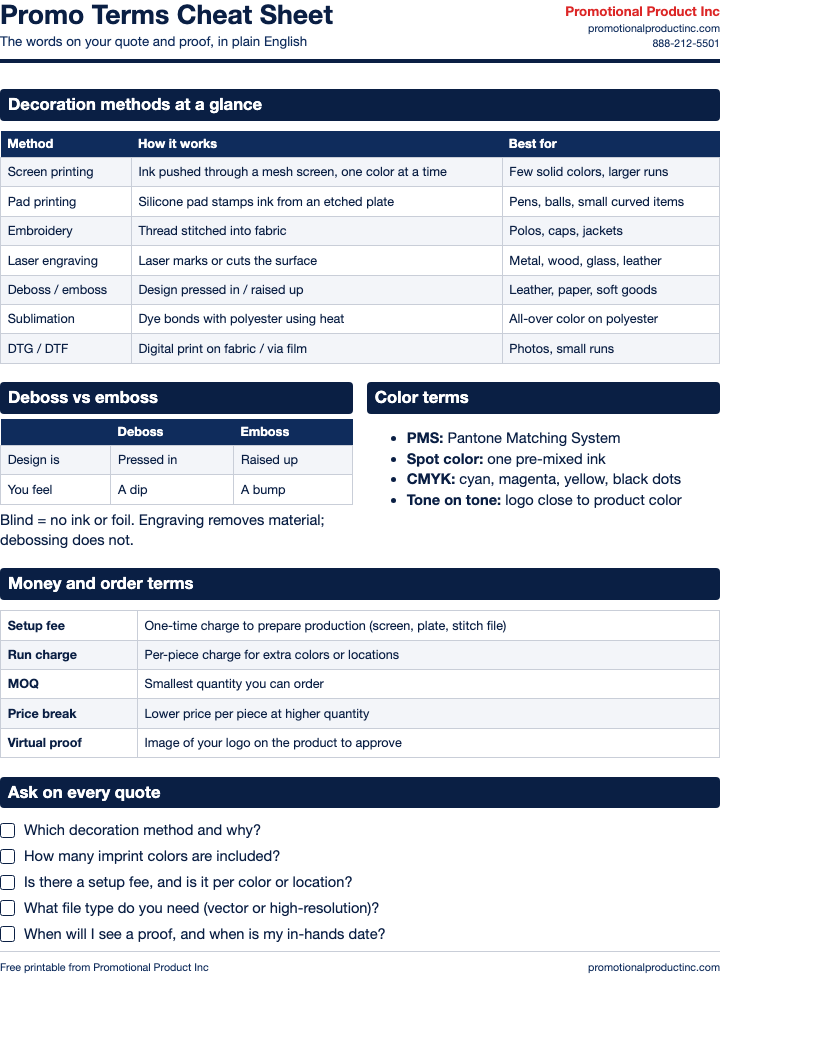
Free printable: Promo Terms Cheat Sheet
One page with every decoration method, deboss vs emboss, color terms, pricing terms and five questions to ask on every quote.
Open the free PDF1 page, US Letter. Opens in a new tab to print or save.
Not sure which decoration method fits your product? Send us your logo and we will recommend one, with a free proof and a free quote.
Shop Related Categories
Frequently Asked Questions About Promotional Product Terms
What does debossing mean?
Debossing means pressing a design into a material so it sits below the surface. It is common on leather journals, padfolios and silicone wristbands, and a debossed logo cannot rub off.
What is the difference between deboss and emboss?
Deboss presses the design in so it looks sunken, and emboss raises it so it stands out. Both can be done without ink, which is called blind, or with color fill or foil.
What is the difference between PMS and Pantone colors?
There is no difference for ordering purposes: Pantone is the company, and PMS, the Pantone Matching System, is its color system. People use both names for the same thing.
What is a setup fee?
A setup fee is a one-time charge to prepare your order for production, such as making a screen or an embroidery file. It is usually charged per color or per imprint location.
Is screen printing or digital printing better?
Screen printing is usually better for simple designs and larger quantities, and digital printing is better for full-color, photo-style designs and small quantities. The right choice depends on your artwork and your quantity.
Share this post with your team
Send it to a colleague or save it for later.
Related Articles
What Is Recycled Polyester? RPET and Other Eco Materials
What recycled polyester and RPET mean, how non-woven polypropylene and wheat straw plastic differ, and how to describe eco materials on branded bags, drinkware and pens without overclaiming.
Logo Placement on Shirts: Where, What Size and Which Method
Where the logo goes on a shirt, polo or hoodie, how big it should be, how to measure it, and when to pick screen printing or embroidery, with a size table and a free cheat sheet.
What Is a Tchotchke? Meaning, Pronunciation and Examples
What is a tchotchke? The meaning of the word, how to pronounce and spell it, where it comes from, and why marketers call small branded giveaways tchotchkes.
Hat Sizes: How to Measure Your Head, a Full Hat Size Chart and What OS Means
A plain-English guide to hat sizes: how to measure your head in one minute, a full hat size chart in inches and centimeters, what OS means on a size label, and how to size hats for a group.