
Custom T-Shirt Cost: What Drives the Price and How to Pay Less in Bulk
 Olivia SmithLead Content Strategist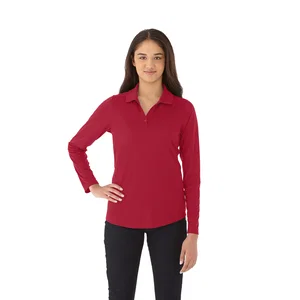
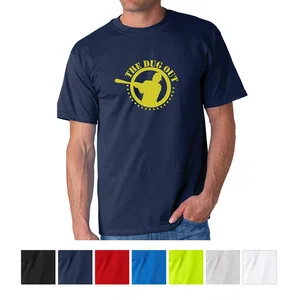
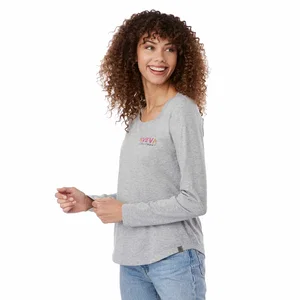

Custom t-shirt cost is set by seven things: quantity, the shirt itself, the print method, the number of colors, the number of print locations, setup, and timing and shipping. Change any one of them and the price per shirt moves. This guide explains each lever in plain language, shows you how to read a price table without getting surprised, and ends with a quote request you can paste into an email so every quote you collect can be compared line by line. There are no price lists here on purpose, because prices change. The product cards on this page show our live starting prices, so look at them for today's numbers.
Custom T-Shirts With Today's Starting Prices
View all custom t-shirts →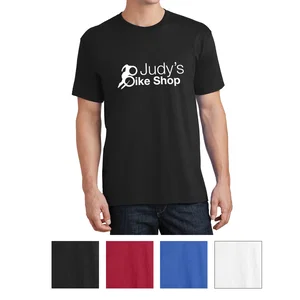
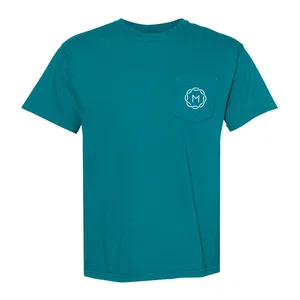
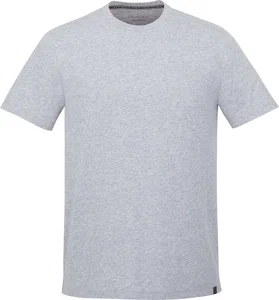

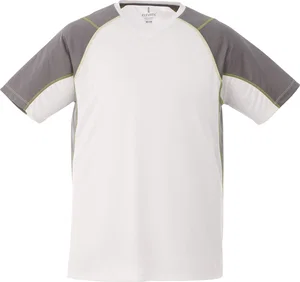
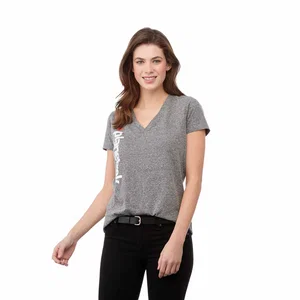
Custom t-shirt cost is easiest to judge with real numbers in front of you. The cards above show our live starting price for each shirt, so they are always current. Use them as a starting point, then use the rest of this guide to understand why the price on a card can go up or down once you add your own quantity, colors and deadline.
The Seven Things That Set T Shirt Printing Cost
T shirt printing cost comes from seven levers: how many shirts you order, which shirt you choose, how it is decorated, how many ink colors the design uses, how many places on the shirt carry a print, the setup work behind the job, and how fast and how far the order has to travel. Most people only think about the first one. The other six explain why two orders of the same size can land at different totals.
Here is the short version in one table, followed by what each lever means and how to use it.
| Lever | Raises the price | Lowers the price |
|---|---|---|
| Quantity | Ordering just under a break | Ordering at or above a break |
| The shirt | Premium fabric, heavier weight, larger sizes, dark colors | Standard cotton, lighter weight, white or light colors |
| Print method | A method that does not match your quantity | The method that fits your quantity and art |
| Number of colors | More ink colors in screen printing | One or two colors, or a method that prints many colors at once |
| Number of locations | Front, back and sleeve prints | One print location |
| Setup | Many colors, many locations, artwork that needs rework | Clean artwork, one location, reorders of the same design |
| Timing and shipping | Rush production, many ship-to addresses | Enough lead time, one delivery address |
1. Quantity
Why it moves the price: a print job has fixed work that costs the same whether you order a few shirts or a few hundred. The more shirts that share that work, the less each shirt carries. That is why the price per shirt steps down at set quantities, which we cover in detail in the next section.
How to use it: treat your headcount as a starting guess, not a final number. Before you lock in a quantity, look at where the next break sits. Many buyers find that a slightly larger order lowers the per-shirt price enough to matter.
2. The Shirt Itself
Why it moves the price: the shirt is the base of the t-shirt printing cost, and shirts are not all alike. A premium fabric, a heavier shirt, a tri-blend feel or a performance tech tee costs more to buy than a basic cotton tee. Larger sizes can cost more too. Color matters as well: white and light shirts are usually the lowest-priced colors, and dark shirts can need an underbase, which is a layer of white ink that lets lighter colors show up. That extra layer adds work.
How to use it: match the shirt to the job. A one-day event shirt does not need the same fabric as a staff uniform people will wear for years. If the design works on a light shirt, choosing one is the easiest saving available. For help picking fit and sizes, see our T-shirt size chart.
3. The Print Method
Why it moves the price: each method has its own mix of setup and per-shirt cost. Screen printing has more setup per color but a low per-shirt cost at volume. Digital transfer and other direct digital methods have less setup and suit small runs and designs with many colors. Embroidery is priced by stitch count. A method that does not fit your quantity can make the same shirt cost more than it should.
How to use it: let the quantity and the artwork choose the method. A few dozen shirts with a full-color logo usually point one way, and several hundred shirts with a two-color logo point another. We compare the methods in detail further down.
4. The Number of Colors
Why it moves the price: in screen printing, every ink color needs its own screen and its own pass, so each added color adds setup and press time. In digital transfer, the listed price often covers a range of colors in one location, so a many-color design does not change the price the same way.
How to use it: count the colors in your design the way a printer would. A gradient or a photo is many colors. A flat logo in one brand color is one. If your design has four colors and one of them is a thin accent line, ask whether the design still works without it.
5. The Number of Print Locations
Why it moves the price: the listed price usually includes a set number of locations, often one. A left-chest print plus a full back print plus a sleeve print is three locations, each with its own work. Each added location adds to the price and, depending on the method, adds to setup too.
How to use it: decide which location carries the message. For most events and teams, one clear print on the front or back does the job. If you want two locations, ask the shop what the second one adds before you commit.
6. Setup
Why it moves the price: setup is the work done before the first shirt is printed, such as preparing artwork, making screens for screen printing or digitizing a design for embroidery. Each decoration method carries a setup charge on our listings. You pay it once per job, so it matters more on a small order than a large one.
How to use it: send clean artwork, keep the design simple, and ask whether the setup charge is included in the quote and whether it is charged per color or per location. If you plan to reorder the same design later, ask whether a repeat order carries a lower setup charge, since the work may already be on file.
7. Timing and Shipping
Why it moves the price: rush production costs more because the shop has to move your job ahead of others. Shipping to many addresses costs more than shipping one box to one place, because each address means separate packing and a separate carrier charge.
How to use it: order earlier than you think you need to, and ship to a single address when you can, then hand shirts out in person. Our production time guide for buyers explains how to count backward from your in-hands date.
How Quantity Breaks Work When You Order in Bulk
A quantity break is a set number of shirts at which the price per shirt drops to the next step. Instead of one price for any amount, a price table is a ladder. You start on the first rung, which is the minimum order, and each rung above it has a lower price per shirt. This is the single biggest reason bulk orders cost less per shirt than small ones.

Two Real Ladders
The ladders below are listed on two of our shirts at the time of writing. Break points differ by shirt and method, so check the product page for today's breaks.
| Shirt and method | Minimum order | Price steps down at |
|---|---|---|
| Screen-printed cotton tee | 96 | 144, 288 and 504 |
| Tee decorated by digital transfer | 12 | 175, 350, 500 and 650 |
Notice two things. First, the minimum order depends on the decoration method. The screen-printed tee starts at 96, while the digital-transfer tee starts at 12. If you need a small batch, that difference alone can decide the method. Second, the breaks are spread differently. The screen-printed tee has closely spaced breaks that reward moving from 96 to 144 to 288. The digital-transfer tee starts low and holds the same price over a wide range before the next step.
The Check-the-Next-Break Trick
Before you finalize your count, find the next break above your number and ask how far away it is. Ordering slightly more can lower the per-shirt price on every shirt in the order, not only the extra ones, and that can matter more than the extra shirts cost.
Here is a worked example in words. Say your team has 135 people and the shirt you like has a break at 144. At 135 shirts you pay the price from the rung below 144. If you order 144, you add nine shirts, but all 144 now sit on the lower rung. Ask the shop to quote both quantities side by side. Sometimes the total for 144 is close to the total for 135, and you end up with nine spare shirts for new hires, lost sizes and late joiners at little extra cost. Sometimes it is not close, and then 135 is the right call. You only know by asking for both numbers.
This trick works in the other direction too. If you are a few shirts above a break and over budget, ask whether dropping to the break still covers everyone. Maybe a few people can share a design or skip the shirt.
Reading a Price Table Without Getting Surprised
A price table lists a price per shirt for each quantity range, and that price covers a stated amount of decoration called "price includes." Most surprises in shirt printing costs come from misreading that one line. When you know how to read it, how much do t-shirts cost stops being a mystery and becomes a set of choices.
What "Price Includes" Means
Every listed price assumes a certain amount of decoration. These are examples from our own listings:
- Screen printing: one-color imprint, one location.
- Digital transfer: one location, up to 8 colors.
- Embroidery: one location, up to 10,000 stitches.
If your order stays inside those limits, the listed printed t shirt price is what applies. If you go past them, with a second color, a second location or a bigger stitch count, you add cost. This is not a trick. It is how the work is counted. A two-color design on one location simply takes more work than a one-color design on one location.
Setup Charges
Each decoration method carries a setup charge on these listings. The charge covers preparing your art and getting the job ready to run. When you compare quotes, check three things: whether setup is included in the total, whether it is charged per color or per location, and whether it repeats if you reorder.
Per-Color and Per-Location Adds
Think of the price table as a base price with add-ons. The base covers the "price includes" line. Extra colors, extra locations and extra stitches are add-ons. When a quote looks low, check whether it covers your whole design or only the base. A quote for "one color, one location" is not comparable to a quote for your actual four-color, two-location design.
Why Two Quotes for the Same Shirt Differ
When someone asks why custom t shirt prices differ so much between shops, the cause is usually one of these:
- The two shops quoted different shirts that look alike but differ in fabric or weight.
- One quote covered one color and the other covered four.
- One quote included setup and the other added it later.
- One quote assumed standard timing and the other included rush.
- One quote included shipping to one address and the other did not include shipping at all.
- The quantities were different, so the shirts sat on different rungs of the ladder.
You can avoid almost all of this by sending the same written request to every shop. The quote section below gives you one to paste.
Custom Shirt Pricing by Method: Screen Printing vs Digital Transfer vs Embroidery
Custom shirt pricing changes with the method, and no method is cheapest in every situation. The right one depends on your quantity, your number of colors and the look you want. Use the table as a quick guide, then read the notes below it.
| Method | Costs less when | Costs more when |
|---|---|---|
| Screen printing | The run is large and the design has one or two colors | The run is small or the design needs many colors |
| Digital transfer | The run is small or the design has many colors | The run is very large and the design is simple |
| Embroidery | The design is small, simple and low in stitch count | The design is large or dense with many stitches |
Screen printing. Screen printing has more setup per color, because each color needs its own screen. That setup is the same whether you print a few shirts or a few hundred, so a larger run spreads it thin and the per-shirt cost at volume is low. This is why screen-printed shirts often start at a higher minimum, like the 96 in our example above. Choose it when you are ordering a larger quantity of a design with one to three flat colors, such as a company logo or an event name.
Digital transfer. Digital transfer and other direct digital methods have less setup and suit small runs and designs with many colors. A full-color logo, a gradient or a small batch of twelve all point here. The listed price on one of our tees covers one location with up to 8 colors, so a colorful design does not climb the way it would with screen printing. For very large runs of a simple one-color design, screen printing can win back the advantage.
Embroidery. Embroidery is priced by stitch count, so size and density drive the price. A small left-chest logo is a common fit, and the listing we looked at includes one location up to 10,000 stitches. A big, dense design takes far more stitches and costs more. Embroidery also reads as a more polished, textured finish, which is why it is popular for staff polos and uniforms.
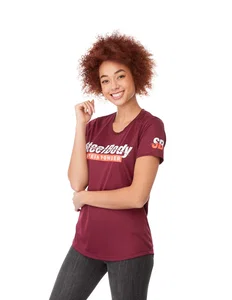
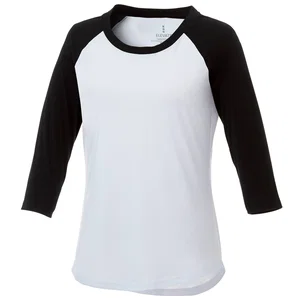
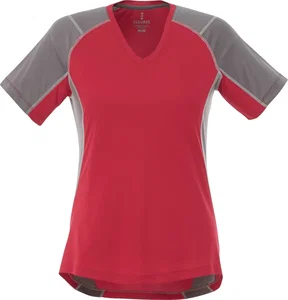
Many shirts list more than one method. A single tee can show digital transfer, embroidery and sublimation, each with its own price table. That is useful because you can compare methods on the same shirt instead of guessing.
Tees Listed With Digital Transfer and Sublimation
View short-sleeve tees →


If you want to put a photo or a many-color image on a shirt, our guide to putting a photo on a T-shirt explains which methods handle it best. And if you are still deciding what to print, the custom T-shirt design ideas post has plenty of starting points that fit a simple, low-cost print.
12 Ways to Pay Less Without a Worse Shirt: Low Cost Custom T-Shirts
You can get low cost custom t-shirts by changing the levers you control, not by buying a worse shirt. Each tip below says what to do and why it works. Pick the ones that fit your order. You do not need all twelve.
- Use fewer ink colors. Cut the design to one or two colors where you can. Each added color in screen printing adds a screen and press time, so fewer colors means less work.
- Print in one location. Put the message on the front or the back, not both. Each added location is added work, so one location keeps you inside the listed price.
- Choose a white or light shirt. White and light shirts are usually the lowest-priced colors. Dark shirts can need an underbase, which adds a step.
- Order at the break. Look at the quantity ladder and order at or just above a break. Your whole order moves to the lower per-shirt price.
- Use one design for everyone. A single design means one setup. Several designs can mean setup for each one, so a shared design keeps the setup charge from repeating.
- Stick to standard sizes. Larger sizes can cost more, so a group that stays in the common range keeps the total lower. Our size chart helps people choose well the first time.
- Avoid rush. Rush production moves your job ahead of others, and that priority costs extra. Order early and you pay the standard rate.
- Combine orders. If two departments or two events need shirts in the same design, order together. A bigger single order climbs the ladder faster than two small ones.
- Simplify the artwork. Clean, flat artwork needs less preparation and prints more reliably. Fine detail and tiny text can add work and risk.
- Choose the method that fits the quantity. Digital transfer for small or colorful runs, screen printing for larger runs with few colors, embroidery for small left-chest logos. The wrong method makes the same shirt cost more.
- Ship to one address. One box to one place avoids the packing and carrier charges of many separate deliveries. Hand shirts out in person.
- Approve the proof fast. A quick proof approval keeps your job on schedule, which protects you from a rush charge later. Slow approvals can eat the lead time you planned.
Even a few of these together can lower your custom t-shirt cost. If you only have time for three, make them fewer ink colors, one location and ordering at the break.
How to Ask for a Quote So Two Quotes Match
The best way to compare custom t-shirt pricing is to send every shop the same written request. When each shop answers the same questions, differences in price show real differences in the offer, not differences in what was asked.

A Quote Request You Can Paste
Copy this, fill in the blanks and send it to each shop:
Quote request for custom T-shirts
- Quantity: [total number of shirts, and a second quote at the next quantity break up]
- Sizes: [how many in each size, or "estimated spread" if not final]
- In-hands date: [the date shirts must be in your hands]
- Shirt type and color: [style, fabric if you have a preference, and shirt color]
- Decoration method: [screen printing, digital transfer or embroidery, or "recommend the best fit"]
- Number of ink colors: [how many colors in the design]
- Print locations: [front, back, left chest, sleeve]
- Print size: [width and height of each print]
- Ship-to: [one address or how many addresses, with city and state]
- Please confirm: [setup charge included, what the listed price includes, and the next quantity break]
Notice the second line in the quantity entry. Asking for a second quote at the next break up gives you both numbers for the check-the-next-break trick. It costs you one sentence and can save real money.
The Free Printable Worksheet
If you would rather fill in a page, we made one. The worksheet has four parts: the order (how many, in-hands date and sizes), the shirt (fabric and weight, and color), the print (method, ink colors, locations and print size) and five questions to ask every shop.
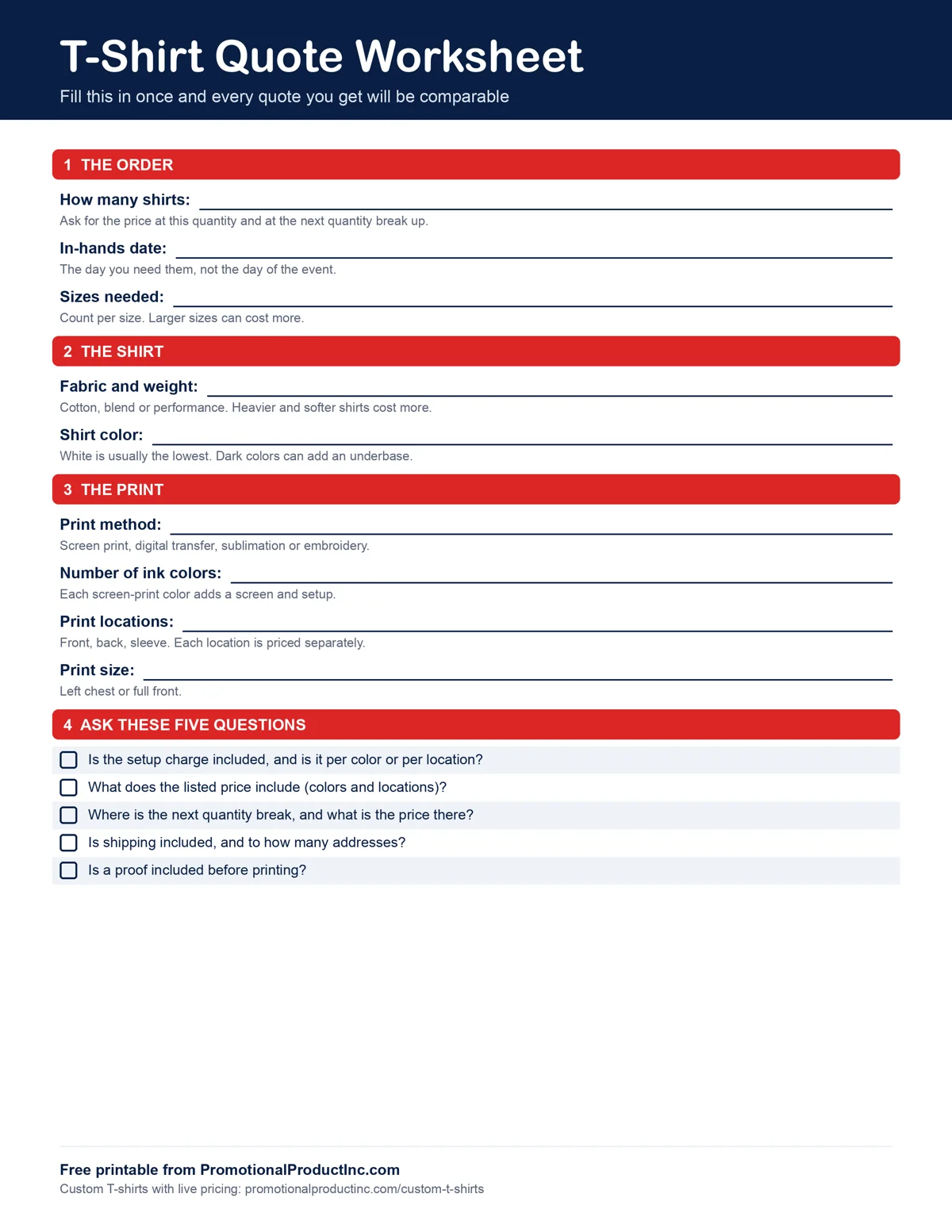
Download the free T-Shirt Quote Worksheet (PDF)
The Five Questions to Ask Every Shop
These five questions on the worksheet are the ones that most often explain a price gap:
- Is the setup charge included, and is it per color or per location?
- What does the listed price include?
- Where is the next quantity break?
- Is shipping included, and to how many addresses?
- Is a proof included before printing?
If a shop cannot answer one of these clearly, treat that as useful information. A clear answer means you can compare. A vague answer usually means a surprise on the invoice later.
Budgeting for a Group Order
A group order is easiest to budget when you set a per-person target first, then work backward to the print choices that fit it. This keeps the conversation about what everyone can spend rather than about the shirt itself.

Follow these steps:
- Decide the total budget. Settle on the amount the company, team or sponsors can spend in total. Write it down so the number does not drift.
- Divide by headcount. Divide the total by the number of people to find a per-person target. This is the figure to keep in mind when you look at the product cards and quotes.
- Collect sizes early. Ask everyone for a size with a simple form. Point people to the T-shirt size chart so they pick the right fit and you avoid exchanges.
- Add a few extras. Order a few shirts beyond the headcount for late joiners, wrong sizes and replacements. Ask for the quote at both your exact count and the count with extras, so you can see what the spares add.
- Check the next break. With extras added, see whether you now sit at a break. Sometimes the spares pay for themselves by moving the whole order to the lower price.
- Choose the print to fit the budget. If the quote is above your target, change a lever you control: fewer colors, one location, a lighter shirt or a different method.
- Split the cost. For a team, club or fundraiser, split the total per person, or offer a sponsor spot on the shirt in exchange for covering part of the order. A sponsor logo on the back is one added color and one added location, so confirm what it adds before you promise it.
- Set the deadline backward. Pick your event date, subtract production and shipping time, and add a few days of cushion. That cushion is what keeps you out of a rush charge.
Custom t-shirt cost stays predictable when a group order has a per-person target, a size list and an early deadline. The orders that do go over usually add a color or a location late in the process.
How Much Does It Cost to Make Custom Shirts in Bulk?
The honest answer is that it depends on the seven levers above, so the best number is the one on today's product cards for your quantity. Custom shirts cost different amounts depending on the shirt, the method, the colors, the locations, the setup, the timing and the quantity, and a single number would hide all of that. Look at the live starting prices on the product cards in this post for today's figures, then fill in the quote worksheet so the shop can price your actual design. If you are asking how much does it cost to print a shirt for a specific event, the worksheet and the next-break question will get you a real answer faster than any average.
Why Do Custom T-Shirt Prices Vary So Much?
Custom t-shirt prices vary because two quotes for the same shirt often cover different things. The shirt may differ in fabric or weight, one quote may include setup and another may not, and the number of colors, locations, quantity and delivery date may all be different. Even the cost of t-shirt blanks changes by style, size and color. Send every shop the same written request and ask the same five questions, and most of the gap disappears.
Is It Cheaper to Print More Shirts?
Yes, the price per shirt usually drops as the quantity rises, because the fixed work of the job is shared across more shirts. The price steps down at set quantities called breaks, so the savings come in steps, not in a smooth slope. The total you pay still goes up when you order more, so the saving is per shirt, not on the whole bill. Ask for a quote at your exact count and at the next break up, then compare the totals.
What Is a Setup Charge?
A setup charge is a one-time fee for the work done before printing starts, such as preparing artwork, making screens or digitizing a design for embroidery. Each decoration method carries a setup charge on our listings. In screen printing, setup is usually tied to each ink color, so more colors mean more setup. You pay it once per job, so it weighs more on a small order than a large one. Ask whether it is included in the quote and whether a reorder of the same design carries a lower charge.
Does the Number of Colors Change the Price?
It can, and how much depends on the method. In screen printing, each ink color needs its own screen and its own pass, so every added color adds cost. In digital transfer, the listed price on one of our tees covers one location with up to 8 colors, so a colorful design does not climb the same way. Count the colors in your artwork as a printer would, and ask the shop what the price includes before you finalize the design.
What Is the Cheapest Way to Print T-Shirts?
The cheapest way is the method that fits your quantity and your artwork, on a light standard shirt, in one location, ordered at a quantity break with enough lead time to avoid rush. For larger runs with one or two colors, screen printing usually gives the lowest cost per shirt. For small runs or designs with many colors, digital transfer usually costs less overall. For a small logo on a polo or hat, embroidery is the common fit. Use the twelve ways above to bring any of them down further.
Ready to price your custom T-shirts? Start with the live prices and send us your quote request.
Shop Related Categories
Share this post with your team
Send it to a colleague or save it for later.
Related Articles

How to Put a Photo on a T-Shirt: Methods, Photo Size and a Free Checklist
A step-by-step guide to printing a photo on a shirt: how to tell if your photo is big enough, which print method suits it, what to send with your order, and a free printable checklist.
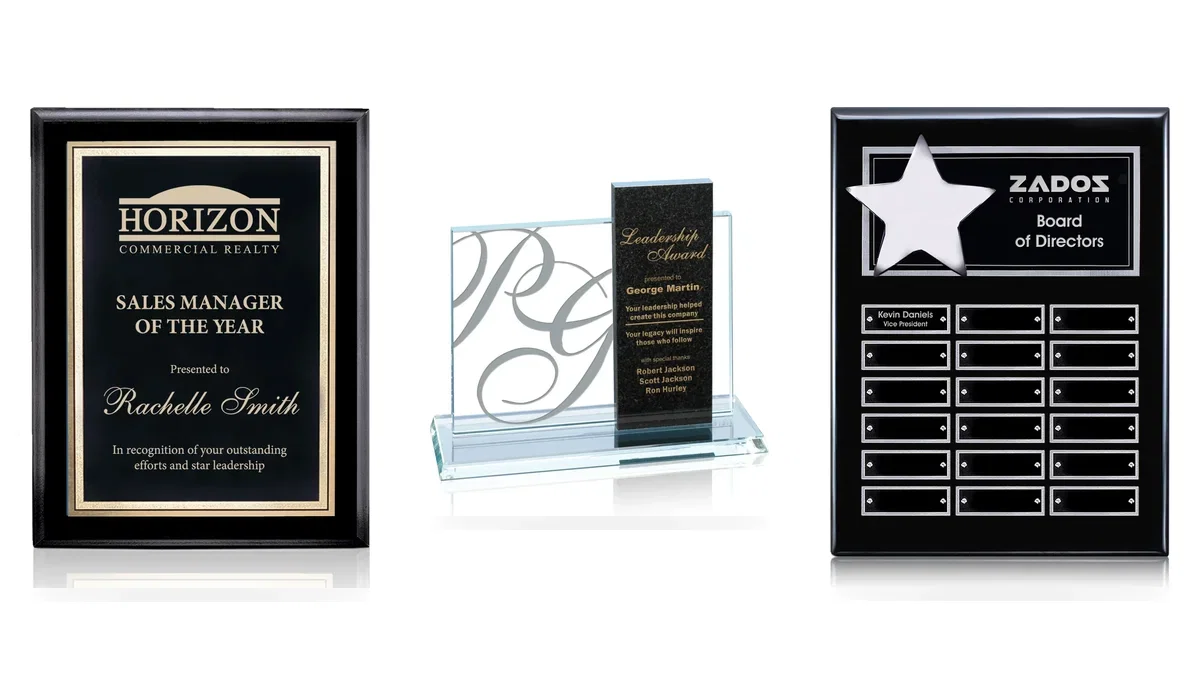
Retirement Plaque Wording and Award Wording Examples
Not sure what to write on the plate? Copy these retirement plaque wording ideas and award wording examples for retirement, appreciation, achievement, dedication, and more, then adjust the names and dates.
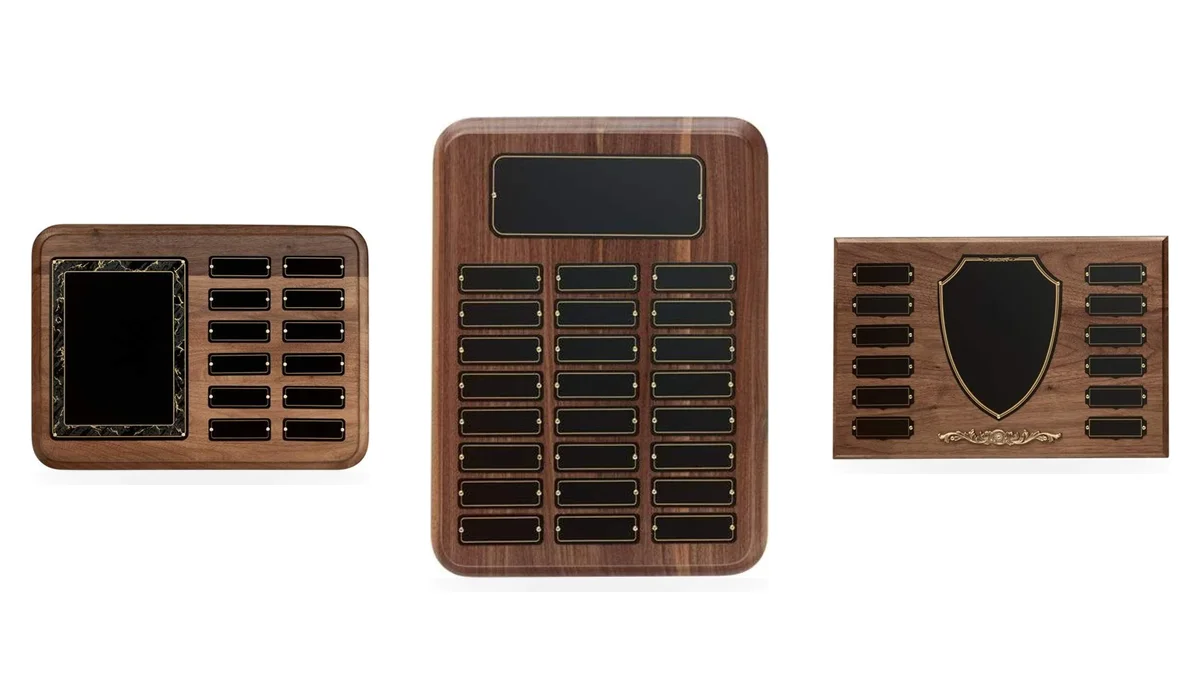
How to Run an Employee of the Month Program That Works
A good employee of the month program is simple, fair, and easy to repeat. Here are the steps, a sample criteria list, and reward ideas that keep people motivated all year.

How to Clean Nylon Totes & Backpacks: Expert Maintenance Tips
If you are searching for how to clean a nylon tote bag or how to wash a nylon backpack, you are in the right place.