
Hat Sizes: How to Measure Your Head, a Full Hat Size Chart and What OS Means

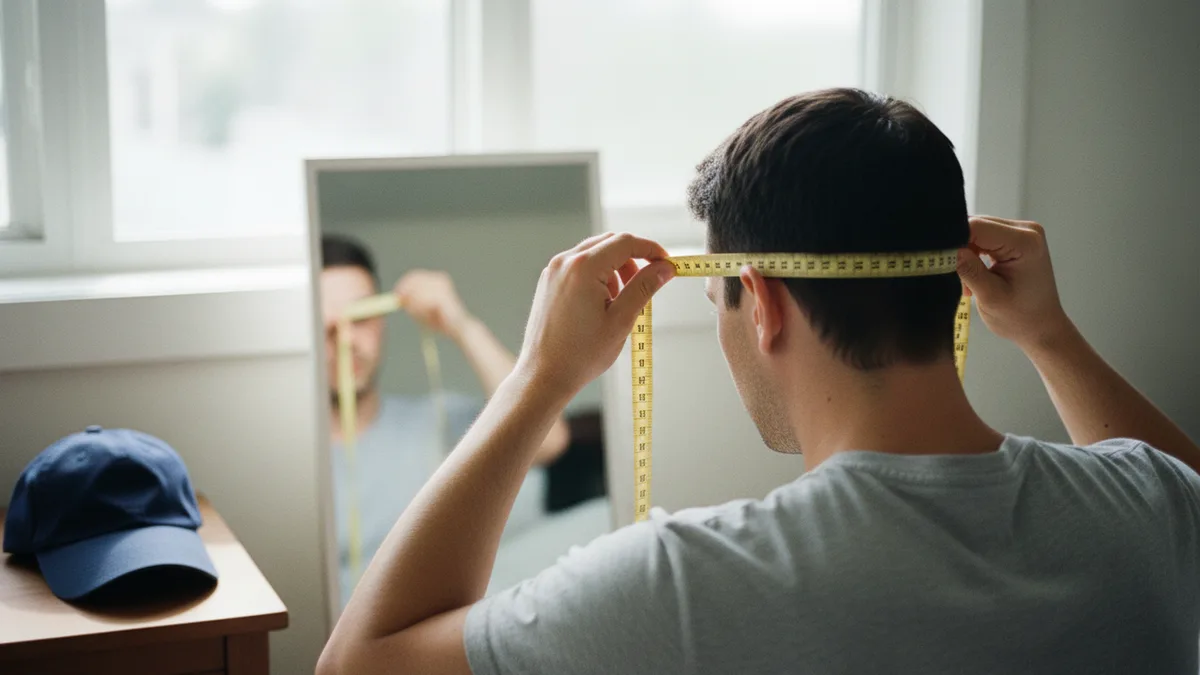
Hat sizes come from one simple measurement: wrap a soft tape measure around your head, read the number in centimeters, and divide it by 8 to get your US hat size. A head of 58 cm is a 7 1/4, and a head of 60 cm is a 7 1/2. This guide shows you how to measure your head in about a minute, gives you a full hat size chart in inches and centimeters, explains what "OS" means on a size label, and covers how to size hats for a team, a crew or an event. Hat sizes are friendlier than they look once you have seen the pattern, and the whole thing takes less time than finding a pen.
One-Size Adjustable Caps for Teams and Giveaways
View all baseball hats →
How to Measure Hat Size in One Minute
To measure hat size, wrap a soft tape measure around your head about a finger's width above your ears and across the middle of your forehead, then read the number where the tape meets itself. That one number is all you need. Everything else in this guide, from the chart to the label codes, builds on it.
If you have been wondering how to find your hat size without a trip to a store, this is it. The method is the same whether you are shopping for yourself, a child, a coworker or a whole team. Here is how to measure for a hat in three steps:
- Wrap the tape. Place a soft tape measure around your head about a finger's width above your ears. It should cross the middle of your forehead, which is where the front of a hat band normally sits. The tape should run level all the way around, so check the back in a mirror or ask a friend.
- Keep it snug, not tight. The tape should touch your head all the way around without pressing in. Read the number where the end of the tape meets the tape. Most tapes show both inches and centimeters, so read the side you need.
- Measure twice. Take the measurement a second time. If the two readings differ, or if your number lands between two sizes on the chart, choose the larger size. A hat that is slightly roomy is easy to fix, and one that is slightly small is not.
Now turn the number into a size with the chart in the next section. Or use the shortcut: centimeters divided by 8.
No Tape Measure? Use a String
A piece of string and a ruler work just as well as a tape measure. Wrap the string around your head in the same place, a finger's width above the ears and across the middle of the forehead. Pinch or mark the spot where the string meets itself. Lay the string flat against a ruler and read the length. That length is your head measurement, ready to check against the chart.
A shoelace, a length of ribbon or a strip of paper cut from a sheet all work too. Avoid anything that stretches, such as a rubber band or a knit scarf, because it will give you a number that is too big.
Common Mistakes When You Measure
Most wrong sizes come from the same few slips. Check this list before you order:
- The tape sits too high. Measuring around the top of the forehead, well above the ears, gives a number that is too large. Keep it a finger's width above the ears.
- The tape is too tight. Pulling hard gives a number that is too small, and the hat will pinch. Snug means it stays in place without leaving a mark.
- Thick hair or a ponytail gets in the way. A bulky bun, braids or a high ponytail can push the tape off level. Flatten the hair as much as you can, or move the ponytail below the tape, and measure the head itself.
- The tape is twisted. A twist in a cloth tape adds length. Smooth it flat before you read it.
- Using the size of an old hat. Hats stretch and shrink with wear, and different makers cut their sizes differently. A fresh head measurement is a better starting point than a tag that has gone through the wash.
Measuring a Child
Measure a child exactly the way you measure an adult, and do it more than once. Kids wiggle, so ask them to sit still and look straight ahead for a few seconds. Let them hold the end of the tape if that makes it a game. If the reading changes between tries, use the larger one, and remember that children's heads grow. Adjustable hats built for kids give a bit of room to grow, which is one reason they are popular for school events and youth teams.
Measuring Someone Else for a Surprise Gift
The easiest trick for a surprise gift is to measure a hat they already own, but only on the inside band. If you can borrow a favorite cap for a moment, lay the sweatband flat and measure along it with a tape or string. Still, the number you get from a worn hat is only a hint. Keep the tag or size label from the gift, and tell the person you are happy to exchange it.
If you cannot get hold of a hat, you can ask a friend or family member what size they usually wear, or choose an adjustable hat that does not need a measurement at all. For a gift, the adjustable route is almost always the safer one. You will see why in the sections on one-size labels below.
Hat Size Chart
Find your head measurement in the first table to read off your US hat size, or use the second table to match a letter size such as M or XL. Both tables describe the same 12 sizes, from a 53 cm head to a 64 cm head.
Remember that this is a US hat size chart. US sizes are written as whole numbers and fractions, such as 7 1/4. Some makers in other regions use a different system, so the cm column is the most reliable way to compare.
Head Measurement to US Hat Size
| Head (cm) | Head (inches) | US hat size |
|---|---|---|
| 53 | 20.9 | 6 5/8 |
| 54 | 21.3 | 6 3/4 |
| 55 | 21.7 | 6 7/8 |
| 56 | 22.0 | 7 |
| 57 | 22.4 | 7 1/8 |
| 58 | 22.8 | 7 1/4 |
| 59 | 23.2 | 7 3/8 |
| 60 | 23.6 | 7 1/2 |
| 61 | 24.0 | 7 5/8 |
| 62 | 24.4 | 7 3/4 |
| 63 | 24.8 | 7 7/8 |
| 64 | 25.2 | 8 |
Common Letter Labels and Hat Sizes
| Common label | Head (cm) | US hat size |
|---|---|---|
| XS | 53 | 6 5/8 |
| S | 54–55 | 6 3/4 to 6 7/8 |
| M | 56–57 | 7 to 7 1/8 |
| L | 58–59 | 7 1/4 to 7 3/8 |
| XL | 60–61 | 7 1/2 to 7 5/8 |
| XXL | 62–63 | 7 3/4 to 7 7/8 |
| XXXL | 64 | 8 |
The letter labels are a common grouping, not a rule. Makers draw the lines in different places, and published charts differ by about a quarter inch. A medium from one maker can fit like a large from another. Use the second table to get a rough idea, then check the size chart for the specific hat you are buying. If the chart for the hat gives a head measurement, that always wins over a general table like this one.
Free Printable Hat Size Chart
Want the whole thing on one page? We made a printable version that you can keep in a drawer, tape inside a closet door or hand to a team captain.
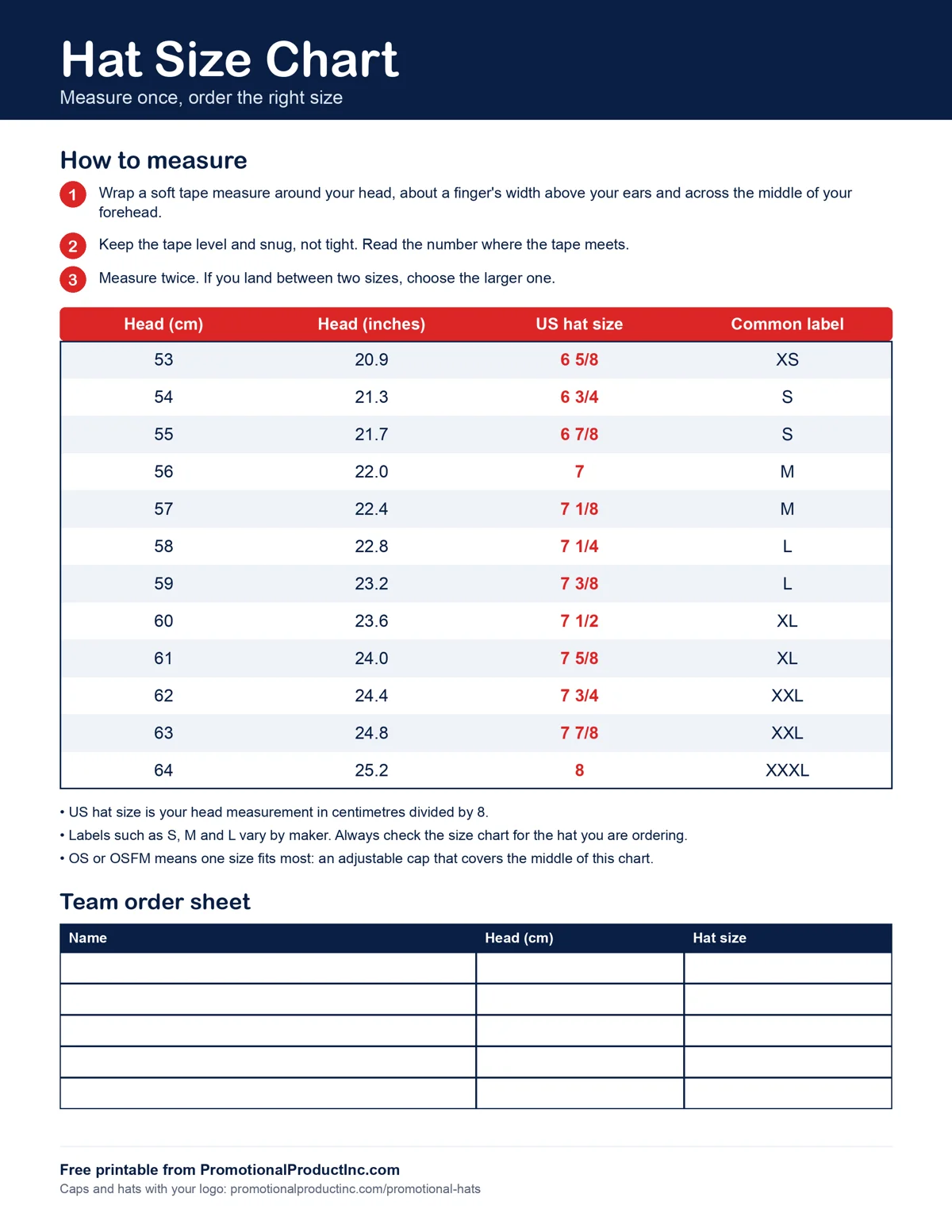
Download the free hat size chart (PDF)
The printable has the three measuring steps, the full 12-row chart with the common labels, three short notes on reading it, and a 5-row team order sheet with a spot for each person's name, head measurement in centimeters and hat size. The team sheet is handy when you are ordering fitted or stretch-fit hats for a group, and we explain how to use it further down.
How Does Hat Size Work and How Is Hat Size Measured?
A US hat size is the diameter of your head in inches, and because you measure around the head instead of across it, the shortcut is to divide the centimeters by 8. That is the whole system. The rest of this section shows why it works.
Here is how is hat size measured in practice. You do not measure across the head, which would be awkward. You measure around it with a tape and then convert. A circle's distance around is a little over three times its distance across, and a centimeter is a little under half an inch. Put those two facts together and the conversion lands very close to dividing by 8.
So how does hat size work when you want to check your own number? Try two examples:
- 58 cm head: 58 divided by 8 is 7.25, which is a 7 1/4 on the chart.
- 60 cm head: 60 divided by 8 is 7.5, which is a 7 1/2 on the chart.
If your result lands between two fractions, round to the nearest size on the chart, and if you are stuck between two, go up. If you want to know how to determine hat size from inches instead, the chart's inches column does the work, so there is no need to convert anything.
Why Fitted Sizes Go Up in Eighths
Fitted hats are sold in steps of one eighth of an inch, such as 7, 7 1/8 and 7 1/4. One step in diameter is a bit under a centimeter and a half around the head, and that is why the chart above climbs about one centimeter at a time. A step that small matters. Fitted hats have no adjuster, so the sweatband has to match the head closely, and the eighth-inch steps give wearers a close match.
That is also why letter sizes are looser. A single "M" has to cover a range of eighth-inch sizes, which is why you should always check the number behind the letter.
What Does Size OS Mean?
Size OS means "one size," and on a hat it tells you the item is adjustable or stretchy and made to fit most adults, so it does not come in separate sizes. If a label says OS, you do not pick a size at all. You pick a color and a style.
If you have ever asked what size is OS, that is the answer. It is not a number on the chart. It is a promise that one hat covers a range of heads, thanks to a strap, a snap, a band or stretch in the fabric.
OS vs OSFM vs OSFA
You may see three codes that look alike. They are used almost interchangeably, but there is a small difference in what they promise:
- OS means one size.
- OSFM means one size fits most. It is the most honest of the three, because it admits that a few heads will not fit.
- OSFA means one size fits all. It is the boldest claim and the one to read with a grain of salt.
In practice, all three tell you the same thing: there is no size choice, and the hat adjusts to fit. When you see OSFM on a product page, take it literally. It was designed for most adults, not every head.
Where You See OS on a Label
One-size labels are common across accessories, not only on caps. You will find OS or OSFM on:
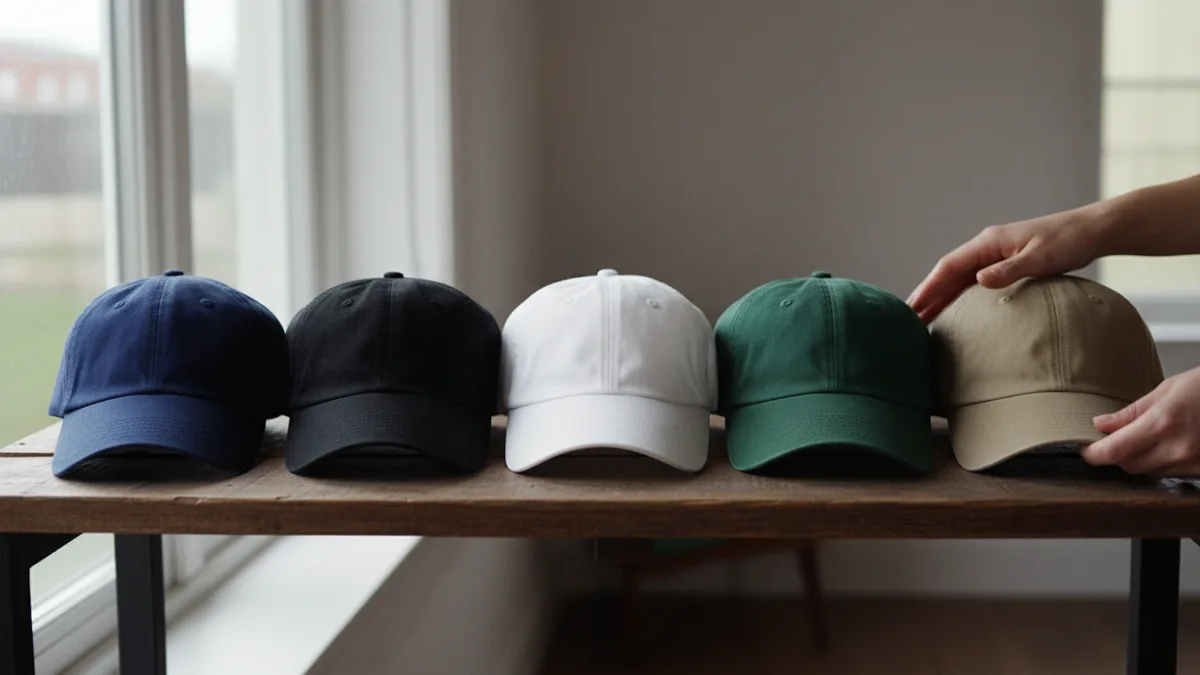
- baseball caps, trucker caps and dad caps
- beanies and knit caps
- visors
- bucket hats
- socks
- gloves
- scarves
- ponchos
The reason is simple. These items either stretch, adjust or are loose by design, so one size works for many people. A scarf does not need a fitted chest measurement, and a poncho drapes over almost anyone.
Who OS Does Not Fit Well
One-size hats fit most adults, but they can feel loose on very small heads and tight on very large ones, and they are usually too big for young children. There is no single number for how far a one-size cap adjusts, because it varies from cap to cap. The product details for each hat are where to look.
If you or someone on your team is outside the usual range, you have a few options:
- Very small head or a child: look for hats made for youth or kids, or add sizing tape inside the band (more on that near the end of this guide).
- Very large head: look for fitted or stretch-fit hats that come in larger sizes, and use the chart above to pick one.
- Not sure: measure the head, then check the product details for the cap you are considering.
Fitted, Adjustable and Stretch-Fit Hat Sizes
Fitted hats come in exact sizes with no closure, adjustable hats use a strap or snap to change the fit, and stretch-fit hats use elastic fabric or a band to flex. Each type handles hat sizes differently, so knowing which one you are buying tells you whether you need to measure at all.
Hat Closures Explained
| Closure | How it adjusts | Best for |
|---|---|---|
| Snapback | A plastic strap with snap holes at the back | Teams, giveaways, casual wear |
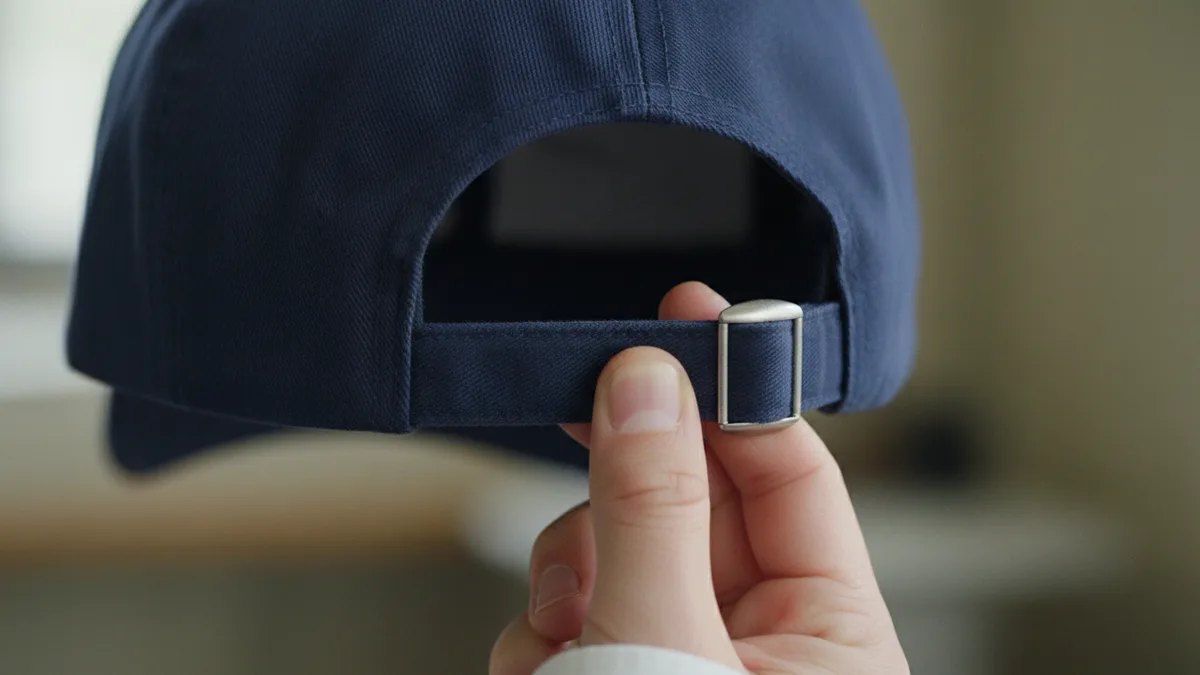
| Strapback with buckle | A fabric or leather strap and a metal buckle | A clean look with fine adjustment |
| Hook-and-loop | A fabric tab that sticks to itself | Quick changes and easy sharing |
| Stretch band | Elastic fabric or an elastic band | A close, flexible fit |
| Fitted (no closure) | None, the size is fixed | An exact fit once you know your size |
A little more on each:
- Snapback: the strap has a row of snap holes, so the wearer chooses a hole. It is easy to adjust and easy to share, which makes it a favorite for teams and giveaways.
- Strapback with buckle: a fabric strap passes through a buckle, so the fit slides smoothly rather than clicking from hole to hole. It suits people who want a more precise fit, and it is the classic look on a dad cap.
- Hook-and-loop: a tab fastens with a sticky closure. It is fast to adjust with one hand, so it works well for kids, for sports and for hats that several people may wear.
- Stretch band: the hat flexes with the head. It gives a close fit with no hardware at the back, and it usually comes in a few size ranges rather than one.
- Fitted: no closure at all. If you know your size, it is the cleanest look. If you do not, it is the easiest one to get wrong.
How Each Hat Type Is Sized
The style of the hat usually tells you how it is sized. Here is how to size a hat by type:
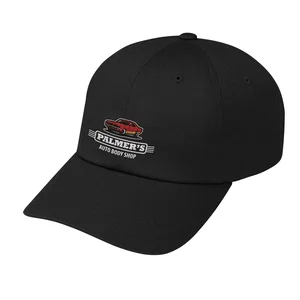
- Baseball cap: structured caps are often fitted or adjustable. If the label says OS, it has a strap or snap. If it shows a number such as 7 1/4, it is fitted.
- Trucker cap: nearly always adjustable, with a snap closure and a mesh back that lets the cap flex a little. It is a safe pick when you do not have head measurements.
- Dad cap: a relaxed, curved-brim cap that usually has a strapback with a buckle. It is typically one size.
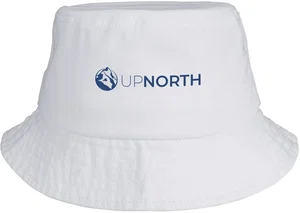
- Bucket hat: often sold in a letter size such as S/M and L/XL, and sometimes in one size. Check the product details for the head measurement it covers.
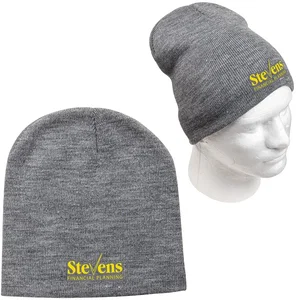
- Beanie: a knit hat that stretches, so it is almost always one size. The cuff or the knit gives the extra room.
- Visor: usually adjustable with a strap or hook-and-loop, since there is no crown to fit.
Trucker Caps, Bucket Hats, Beanies and Visors
View all hats →

Ordering Hats for a Group: A Hat Sizing Guide
For a team, a crew or a giveaway, adjustable one-size caps are the safest choice, because nobody has to know a head size and everybody can adjust their own. This hat sizing guide covers when to collect sizes, when you can skip them and how to keep a group order from going sideways.

When One Size Is Enough
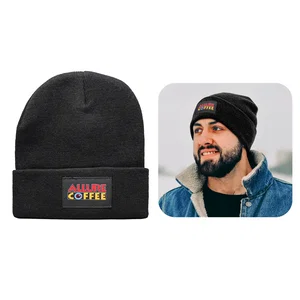
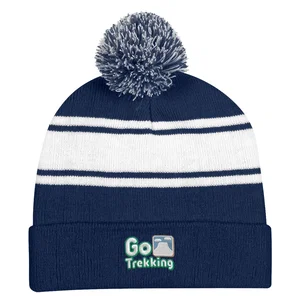
If you are handing out hats at an event or giving them to a large or changing group, choose adjustable. It removes guesswork, and it means a hat that does not fit one person can go to another. Browse promotional hats for the full range, or start with baseball hats and trucker hats, two styles that are almost always adjustable. For cold-weather events, beanies are one size and stretch to fit, and bucket hats work well for sunny outdoor days.
When to Collect Head Sizes
Collect sizes only when you order fitted or stretch-fit hats. In that case, a wrong size is a real problem, because there is no strap to fix it. Ask each person to measure their own head with the steps above, and keep the process simple:
- Send the three measuring steps, or the free printable, to everyone on the list.
- Ask each person to reply with their head measurement in centimeters or inches.
- Use the chart to turn each measurement into a hat size.
- Add up how many of each size you need.
How to Use the Team Order Sheet
The printable includes a team order sheet with five rows and three columns: name, head in centimeters, and hat size. Fill in the name and the measurement, then use the chart to write the matching hat size. When the sheet is full, count the sizes in each column. Print more copies if your group is larger than five.
A few habits make group orders easier:
- Measure twice, and round up when in between. It is the same rule as for one person.
- Order a few extras. A few spare hats in the middle sizes cover late joiners, lost hats and the person who changes their mind.
- Tell people the label rules. If a hat says OS or OSFM, let the group know it adjusts, so nobody worries about a number.
- Check the size chart for the exact hat. Letter sizes vary by maker, so the chart for the style you chose is the one to follow.
More Caps Worth a Look
View all trucker hats →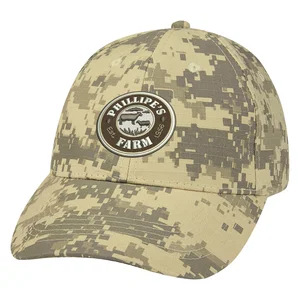
If Your Hat Is Too Big or Too Small
If a hat is a little loose, add a strip of sizing tape or foam inside the sweatband, and if it is too small, exchange it for the next size up. Both fixes are easy, and neither needs tools.
- Loose hat: sizing tape or a thin foam strip goes inside the sweatband, usually at the front or sides. Add a little at a time until the fit feels right. A hat that slips over the eyes after this is simply the wrong size.
- Small hat: do not count on stretching a too-small cap. Structured caps do not give much, and forcing one can warp the crown or the brim. Choose the next size up, or an adjustable style.
- No heat or water tricks: steaming, soaking or stretching a hat on a form can shrink it, warp it or damage any printing or embroidery. If the size is wrong, swap the hat instead.
What Is the Average Hat Size?
Most adult heads fall in the middle of the chart, roughly the M to L rows, and one-size caps are built around that range. That is why OS and OSFM hats work for so many people. If you are looking at the chart and wondering where you stand, the middle rows are the most common place to land, and the rows at either end are where a one-size hat may feel too snug or too loose.
What Size Is a 7 1/2 Hat in Inches and Centimeters?
A 7 1/2 hat size is about 60 cm, which is about 23.6 inches around the head. If you were searching for a 7 1/2 hat size in inches, the answer is 23.6, and for a 7 1/2 hat size in cm, the answer is 60. On a letter scale, that is usually an XL, though letter labels vary by maker.
What Is a Medium Hat Size?
A medium hat size is usually about 56 to 57 cm, which is US 7 to 7 1/8. Because a medium hat size is a loose grouping, one maker's medium can fit like another maker's large. Check the size chart for the specific hat before you order.
How Do I Know My Hat Size Without a Tape Measure?
Use a piece of string, a shoelace or a strip of paper: wrap it around your head a finger's width above your ears, mark where it meets, and lay it flat against a ruler. Then divide the length in centimeters by 8, or find it on the chart. If you only have a ruler in inches, use the inches column of the hat size chart instead.
If you would rather skip measuring, choose a one-size adjustable hat. There is no number to find, because the strap does the work.
Does One Size Fit All Really Fit Everyone?
No, one size fits most adults, not every head. The phrase is a label, and the more honest version is OSFM, which stands for one size fits most. Very small heads, very large heads and children may need a different style. Look at the product details for the cap you are considering, because the range varies from one to the next.
Do Hat Sizes Differ Between Brands?
Yes, hat sizes differ between makers, especially the S, M and L labels. The numbers on a fitted hat, such as 7 1/4, are more consistent than letter sizes, but even those can run a little small or large. Published charts for letter sizes differ by about a quarter inch, so the safest habit is to measure your head and compare it with the size chart for the exact hat.
Need hats for your team or event? Get adjustable caps with your logo on them.
Shop Related Categories
Related Articles
Types of Pens: How to Pick the Right One for Every Job (With a Free Cheat Sheet)
A chooser, not an encyclopedia: which pen to buy or hand out for each job, how pen tips and inks differ, head-to-head verdicts, left-handed tips and a free printable pen picker.

T-Shirt Size Chart: How to Measure and How Many of Each Size to Order
A T-shirt size chart with real chest and length measurements for two blank tees, a two-minute way to measure a shirt, and a paper worksheet for how many of each size to order for a group.
Custom Keychain Ideas: Materials, Styles & Bulk Buying
Custom keychain ideas for bulk brand giveaways: compare metal, leather, acrylic and silicone, weigh engraving against printing, and learn the minimums, costs, and lead times for ordering branded keychains in volume.

Custom Lanyard Ideas: Materials, Clips & Bulk Buying
Custom lanyard ideas for conferences, schools, and staff IDs: compare polyester, nylon, and woven materials, standard widths, clips and ID holders, and how to order in bulk or with no minimum.