
Types of Pens: How to Pick the Right One for Every Job (With a Free Cheat Sheet)

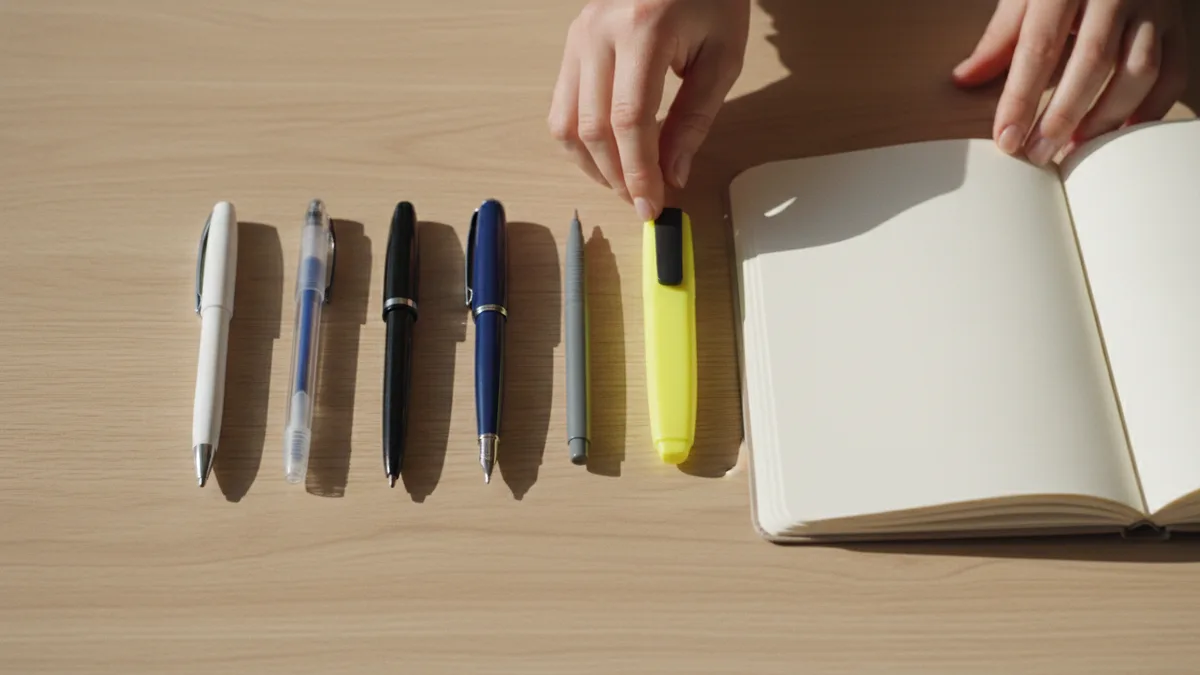
The main types of pens are ballpoint, gel, rollerball, fountain, felt tip and fineliner, markers and highlighters, and stylus pens, and the right one depends on the job: ballpoint for forms and travel, gel or rollerball for smooth signing and long writing, a marker for boxes and plastic, a highlighter for studying. This guide is a chooser, not an encyclopedia. You will get a 30-second picker, a plain-English look at every type, pen tip sizes and ink types explained, head-to-head verdicts, and a checklist for ordering pens with your logo. There is also a free printable cheat sheet. Pens are a small daily pleasure, so we will keep it fun.
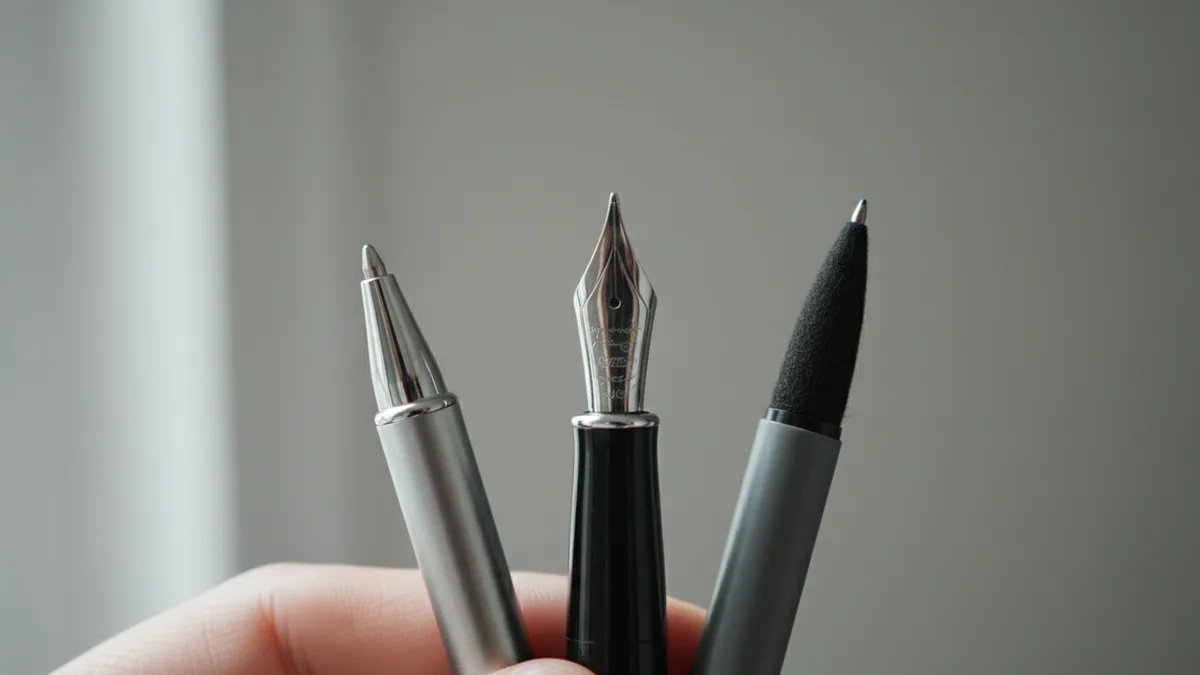
One of Each: Ballpoint, Gel, Rollerball, Stylus, Highlighter and Marker
View all pens →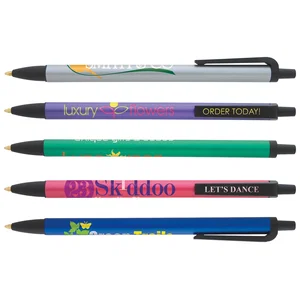
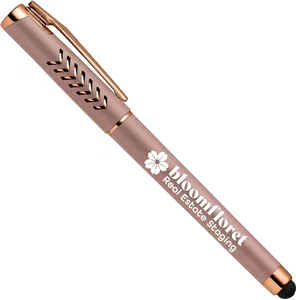
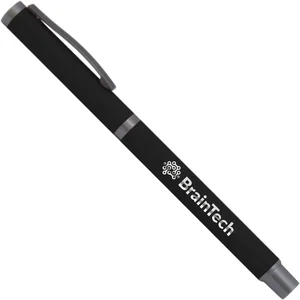

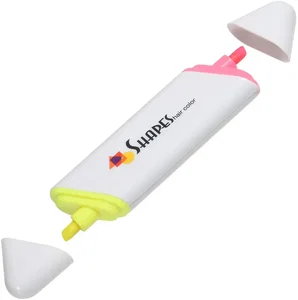
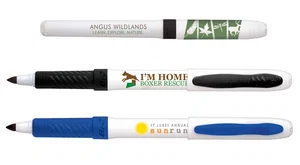
Types of Pens at a Glance: The 30-Second Pen Picker
Find your job in the left column, then buy the pen in the middle column. The right column tells you why, so you can defend the choice to a boss, a client or yourself.
| The job | Best pen | Why |
|---|---|---|
| Everyday notes | Ballpoint or gel | Reliable, comfortable and easy to find |
| Forms with carbon copies | Ballpoint | Firm pressure goes through every layer |
| Left-handed writing | Ballpoint or quick-dry gel, fine tip | Dries fast, so the hand does not drag through wet ink |
| Signing documents and cards | Gel or rollerball, medium tip | A bolder, smoother line looks confident |
| Glossy paper and receipts | Ballpoint | Oil-based ink grips slick surfaces |
| Thin paper and planners | Fine ballpoint or fineliner | A fine line is less likely to bleed through |
| Long writing sessions | Rollerball or gel | Light pressure keeps the hand relaxed |
| Boxes, plastic and labels | Permanent marker | Fast-drying ink sticks to non-paper surfaces |
| Studying and marking up text | Highlighter | Colour sits on top of the words |
| Phones and tablets | Stylus pen | The soft tip registers on a screen |
| Travel and flights | Ballpoint | Thick ink resists leaking |
| Event giveaways | Click ballpoint | No cap to lose and one-hand use |
| A gift or a signing moment | Metal rollerball or pen set | Weight and finish say "this was chosen" |
Want to keep it on your desk? Here is the printable version, with a pen tip size guide on the back.
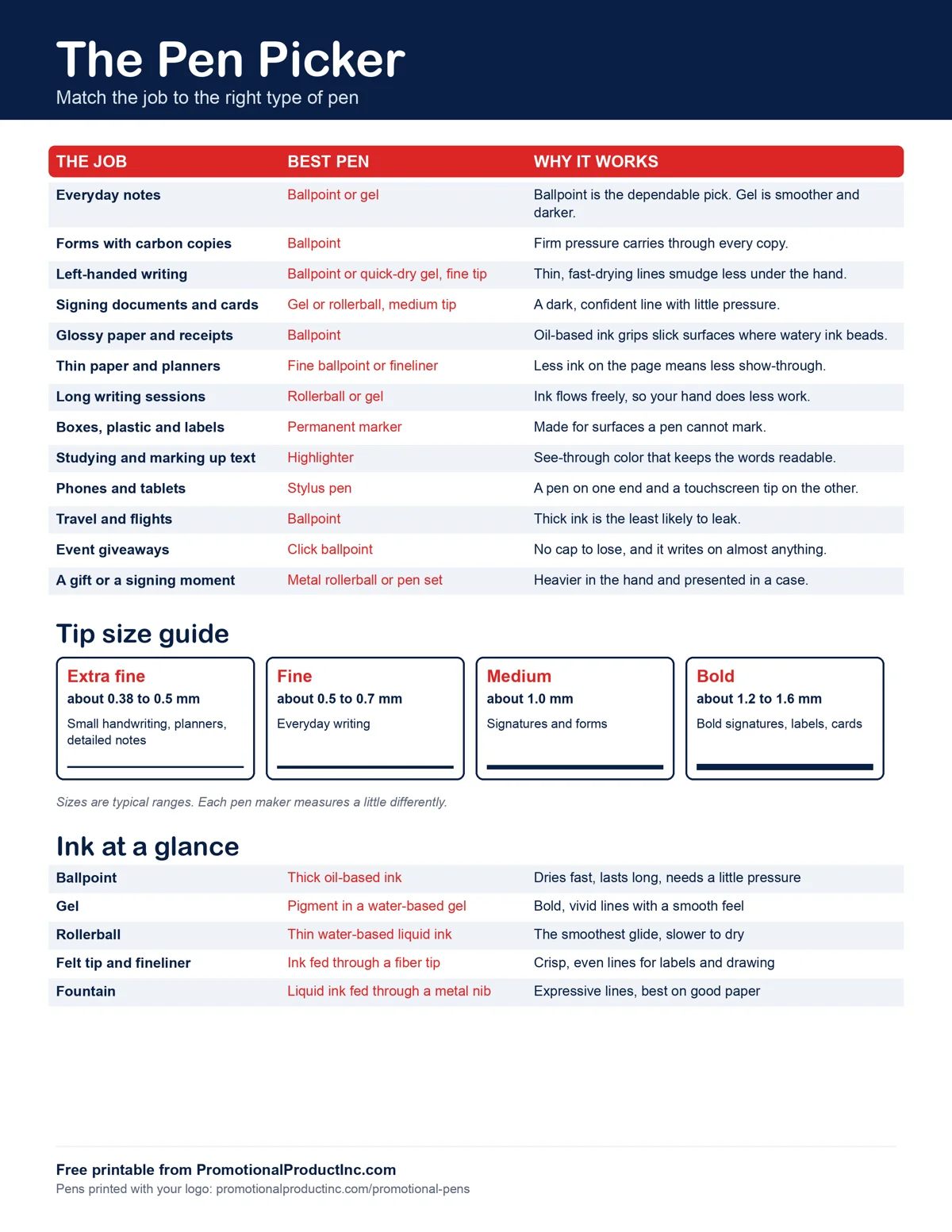
Download the free Pen Picker cheat sheet (PDF)
The Different Types of Pens, One by One
There are seven everyday types of writing pens: ballpoint, gel, rollerball, fountain, felt tip and fineliner, markers and highlighters, and stylus or multifunction pens. Dip and brush pens are a small eighth group for lettering fans. These different pen types differ in three ways: the tip that touches the paper, the ink that flows through it, and the way the pen opens and closes. Each section below gives you how it works, how it feels, what it is best for and what to watch out for.
Ballpoint Pens
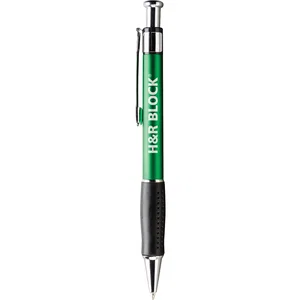
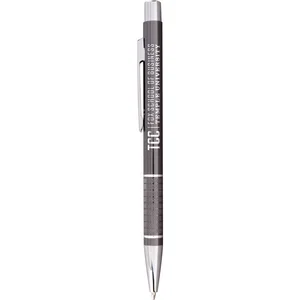
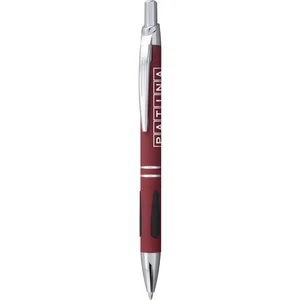
A ballpoint pen is the workhorse: a tiny rolling ball in the tip picks up thick, oil-based ink and lays it on the page. It is the pen most people picture when they hear "pen", and most promotional pens are ballpoints for good reason.
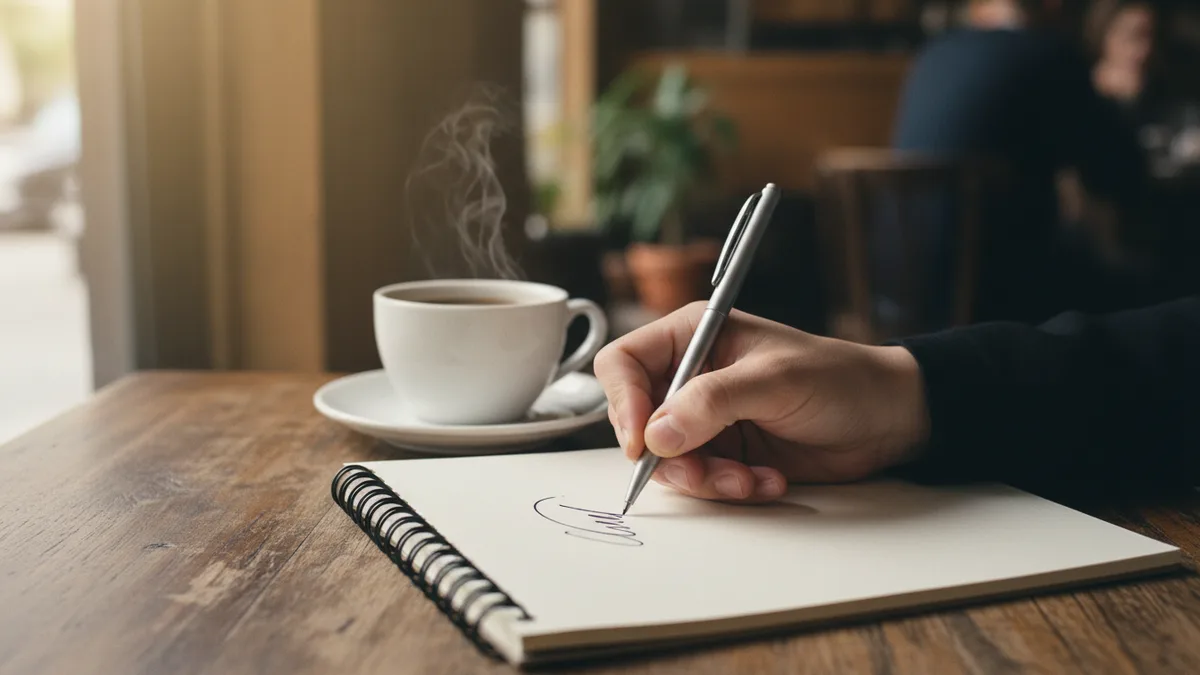
- How it feels: a little firmer and more drag than gel. You press a bit harder, and the line is steady and clean.
- Best for: everyday notes, forms, carbon copies, receipts, glossy paper, travel bags and event giveaways.
- Watch out for: a slightly rougher feel on long writing sessions, and the occasional small blob of ink that gathers at the tip on older or cheaper pens.
If you want a tough everyday option, browse ballpoint pens or the full range of promotional pens.
Ballpoint Pens for Everyday Writing
View all ballpoint pens →

What Is a Gel Pen?
A gel pen is a ball-tip pen filled with a thick, water-based gel ink that flows smoothly and shows a rich, dark line. The ball is the same idea as a ballpoint, but the ink is looser, so you write with a lighter touch.
- How it feels: smooth and easy, almost like gliding. The line looks bolder than a ballpoint line of the same size.
- Best for: signing, journaling, planners, note-taking and anyone who likes a richer colour.
- Watch out for: a slower dry time than ballpoint, so a hand dragged across a fresh line can smudge it. Gel ink also gets used up a little faster than oil-based ink.
A gel pen with a fine tip is a very good everyday pen. Our gel pens come in plenty of barrel styles, and many double as stylus pens.
Rollerball Pens
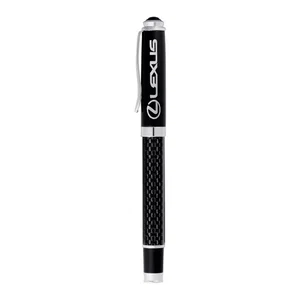
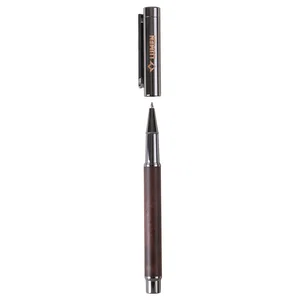
A rollerball pen uses a thin, water-based liquid ink, so it needs almost no pressure and gives the most fluid line of any ball-tip pen. Think of it as the middle ground between a gel pen and a fountain pen.
- How it feels: very smooth, light and quiet. The line is dark and crisp.
- Best for: signatures, thank-you notes, long writing sessions and executive gifts.
- Watch out for: ink that can bleed through thin paper and takes a moment to dry. Press lightly, because the pen does the work.
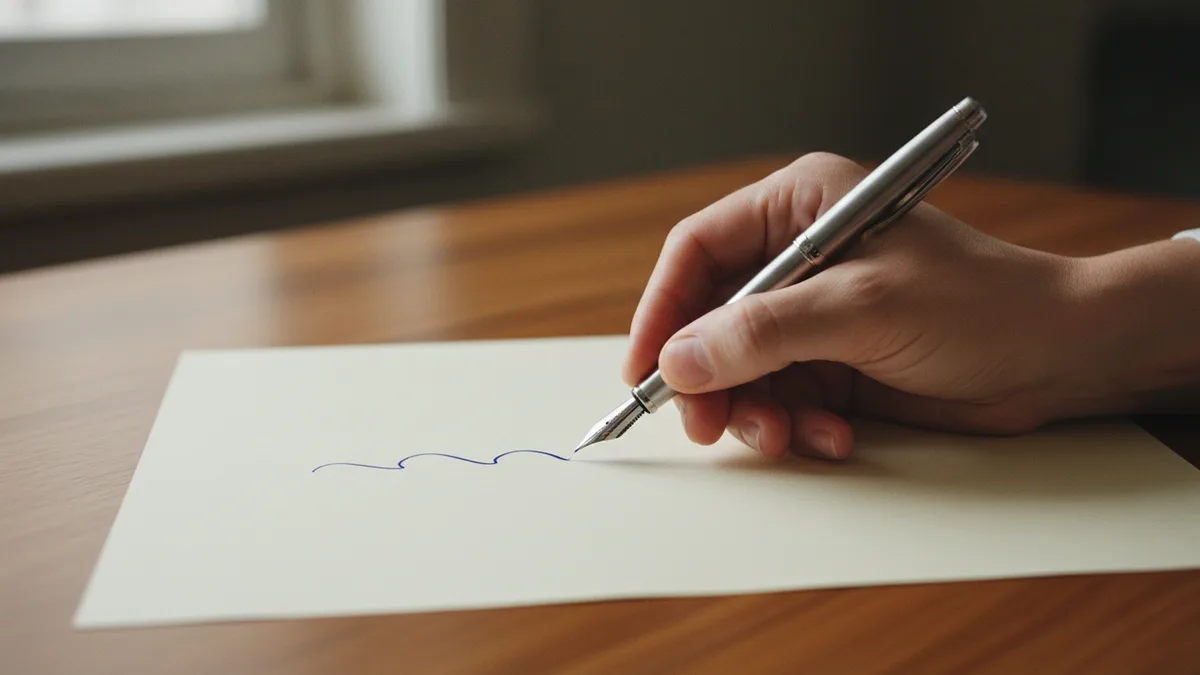
Rollerballs look best in a metal barrel, which is why they show up so often in pen sets and as signing pens at banks and law offices.
Gel and Rollerball Pens for a Smoother Line
View all gel pens →
Fountain Pens
A fountain pen writes with a metal nib that draws liquid ink from a reservoir, which gives the most expressive line and the most ceremony. The nib has a thin slit, and the ink travels down it as you write.
- How it feels: effortless, with almost no pressure. The line can vary from thin to thick depending on the angle and the nib.
- Best for: personal letters, signing a contract, and people who enjoy the ritual of writing.
- Watch out for: slow drying, the chance of a smudge, and a need to cap it and keep it upright. It is a poor choice for a crowd giveaway, because ink and bags do not always get along.
Felt Tip Pens and Fineliners
A felt tip pen writes with a soft fibre tip that carries water-based ink straight to the page, and a fineliner is the same idea with a very thin point. The tip is a bundle of fibres, not a rolling ball.
- How it feels: soft and flexible, with no drag at all. The line is even and bold, and it can look a little like a marker.
- Best for: planners, sketching, labelling and neat small handwriting (a fineliner shines here).
- Watch out for: ink can show through thin paper, and the soft tip wears down faster if you press hard. Always put the cap back on.
Markers and Highlighters
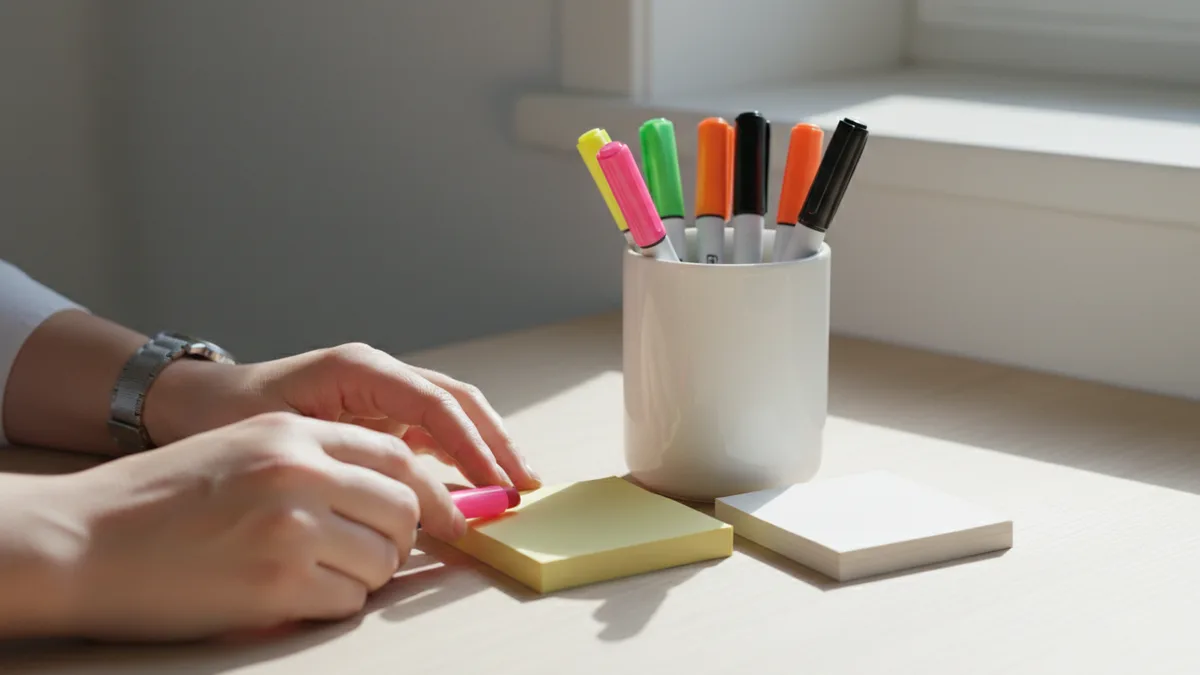
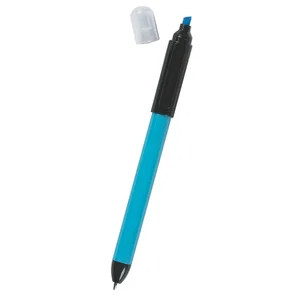
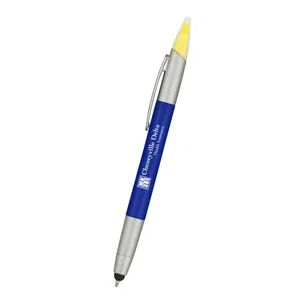
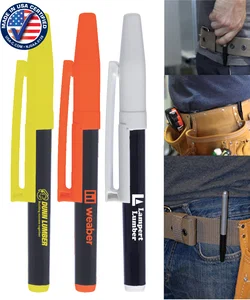
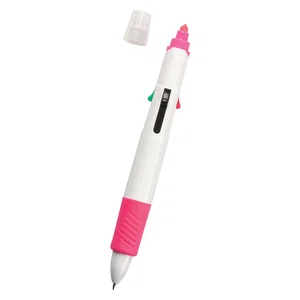
A marker is a broad-tip pen that lays down a lot of fast-drying ink, and a highlighter is a marker with see-through ink made to sit on top of printed words. Permanent markers use alcohol-based ink, which sticks to plastic, metal and cardboard.
- How it feels: wide, soft strokes with very little effort.
- Best for: labelling boxes and bags (permanent marker), studying and marking up text (highlighter), signage and quick sketches.
- Watch out for: permanent ink has a strong smell and bleeds through paper. Highlighters can smear some inks, so test on a corner first.
Browse our highlighters for desk and study giveaways.
Highlighters, Markers and Multifunction Pens
View all highlighters →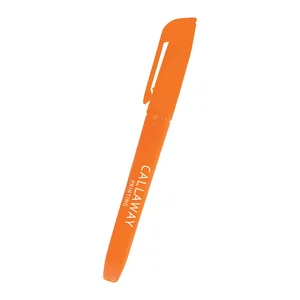

Stylus and Multifunction Pens
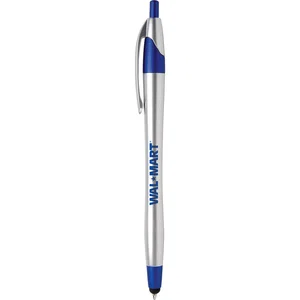
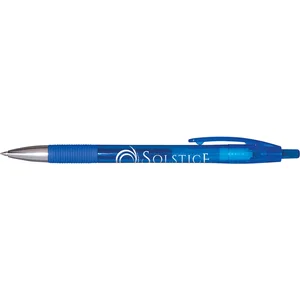
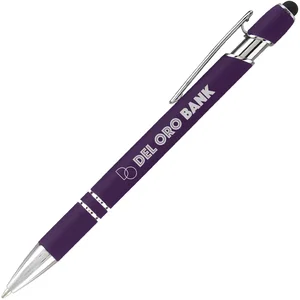
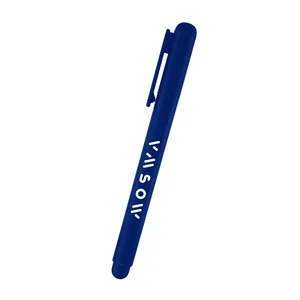
A stylus pen has a soft rubber tip on one end that works on a touchscreen and a pen on the other, so one tool signs the form and taps the tablet. A multifunction pen goes further, adding a highlighter, a light, a screwdriver or a level.
- How it feels: like any ballpoint or gel on the writing end, with a slightly springy tip on the screen end.
- Best for: banks, clinics, tech events and anyone who signs on a tablet.
- Watch out for: a very thin or very light barrel can feel flimsy. Check the weight and the grip. Our post on a pen that works on their phone too covers how to choose one that earns a pocket spot. For more, see stylus pens and multifunction pens.
A Short Note on Dip and Brush Pens
Dip pens use a metal nib that you dip into a bottle of ink, and brush pens have a flexible tip that makes thick and thin strokes like a paintbrush. Both are for lettering and art, not for a desk drawer or a goodie bag, so we mention them for completeness and leave them there.
Types of Pen Tips and Pen Tip Size: What the Tip Does to Your Writing
The tip is where the pen meets the paper, so it decides the line. There are five pen tip types worth knowing, and each one belongs to a family of pens.
- Ball tip: a tiny ball turns as you write. Found on ballpoint, gel and rollerball pens. Clean, steady lines.
- Nib: a metal point with a slit that guides liquid ink. Found on fountain pens. A flowing, expressive line.
- Fibre or felt tip: a soft bundle of fibres. Found on felt tip pens and fineliners. A smooth, even line with no drag.
- Chisel tip: a flat, angled edge. Found on highlighters and some markers. Wide strokes and thin edges.
- Brush tip: a flexible, tapered point. Found on brush pens. Thick-to-thin lines that depend on pressure.
Pen Tip Size: Extra Fine, Fine, Medium and Bold
Pen tip size describes how wide the line is, and for most people a fine tip is right for everyday writing and a medium tip is right for signing. These are the different pen tips most makers use, with typical ranges. Makers measure differently, so the same label can feel a little different from one pen to another.
| Pen tip size | Typical width | Best for |
|---|---|---|
| Extra fine | About 0.38 to 0.5 mm | Small handwriting, planners, thin paper |
| Fine | About 0.5 to 0.7 mm | Everyday notes and general writing |
| Medium | About 1.0 mm | Signatures and filling in forms |
| Bold | About 1.2 to 1.6 mm | Bold signatures and labels |
Two quick rules help. Smaller numbers mean a thinner line and more control. Bigger numbers mean a bolder line and a smoother feel, which is why a medium tip is the usual choice for a signature. When you compare pen point sizes between two pens, use the number as a guide and then try them on paper.
A note on terms: you will see "tip", "point" and "nib" used loosely. These types of pen points are mostly the same idea, so if a pen says "fine point", read it as "fine tip".
Types of Pen Ink: Dry Time, Smudge and Feel in Plain Words
Ink changes how a pen behaves more than almost anything else, and there are six main pen ink types: oil-based, water-based liquid, gel, hybrid, alcohol-based and erasable. Here is how each one handles in everyday use.
- Oil-based ink (ballpoint). Thick and slow-moving. Dry time is short and smudging is rare, so it is a good friend to left-handed writers. It feels a little firm and needs more pressure. It also keeps writing for a long time, which makes it the practical choice for giveaways.
- Water-based liquid ink (rollerball and fountain). Thin and free-flowing. It needs almost no pressure and gives a dark, crisp line. Dry time is longer, so it can smudge, and it may show through thin paper.
- Gel ink. A thicker water-based ink that sits between oil and liquid. It gives a bold, smooth line and a rich colour. It dries more slowly than oil-based ink, so give it a moment before you touch it.
- Hybrid or low-viscosity ink. A newer middle ground between oil-based and gel. It writes more smoothly than a classic ballpoint and dries quicker than most gels, so it suits people who want a smoother pen without the smudging. It is a good pick for left-handed writers and for everyday use.
- Alcohol-based ink (permanent markers). It dries fast and sticks to plastic, metal and cardboard. It is water-resistant and often has a noticeable smell. It bleeds through paper, so it is for marking things, not for writing letters.
- Erasable ink. Made so the writing can be rubbed out with the pen's own eraser. It is handy for planners and school work. Check that it is the right ink for anything important, because erasable writing is not meant for contracts or records.
If you remember one thing from the section on pen ink types, make it this: faster drying means fewer smudges, and smoother flow means less hand effort. Most pens trade one for the other.
Head-to-Head: Ballpoint, Gel, Rollerball and Felt Tip Compared
These four matchups come up most often, and each one has a clear winner for most people.
Ballpoint vs Gel
For everyday giveaways and forms, ballpoint wins; for signing and writing you want to enjoy, gel wins. In a ballpoint vs gel test, the ballpoint dries faster, resists smudging and runs longer on a refill. The gel pen feels smoother, writes a bolder line and asks for less pressure. If a pen will live in a bag, a car or a hotel drawer, pick ballpoint. If it will sit on a desk and get used for notes all day, pick gel.
Gel vs Rollerball
For a pen that is nice to sign with, rollerball wins; for a pen that is easier to live with, gel wins. Rollerball ink is thinner, so it glides with almost no pressure and gives the crispest line, but it needs a moment to dry and can bleed through thin paper. Gel ink is thicker, so it is steadier and less likely to bleed. A rollerball is the better gift. A gel pen is the better daily pen.
Felt Tip vs Ballpoint
For small neat writing and planners, a fineliner wins; for forms, receipts and anything that has to last, ballpoint wins. In a felt tip vs ballpoint comparison, felt tip gives an even, soft line with no drag, but it can bleed through thin paper and the tip wears out sooner. A ballpoint is tougher, works on more surfaces and does not mind being tossed in a bag.
Pen vs Marker
Use a pen to write and a marker to mark. A pen gives you control on paper, while a marker lays down a wide, fast-drying line that works on boxes, plastic, glass and signs. If you need to write on anything that is not paper, reach for a permanent marker. If you need to write a note anyone will read, use a pen.
Pen Mechanisms: Click, Twist, Cap and Stick
For a giveaway, click pens win because there is no cap to lose and you can use them with one hand. The mechanism is the part that opens and closes the pen, and it affects how the pen behaves in a bag, a pocket or a crowd.
- Click (retractable). Press the top and the tip comes out. No cap, one-handed, and the tip is tucked away in a pocket. Best all-round for giveaways. Browse click pens.
- Twist. Turn the barrel and the tip extends. It feels more premium and is common on metal pens. Good for gifts and office use.
- Cap. A cap protects the tip and keeps ink from drying. It is good for rollerballs and fountain pens, but caps get lost, so it is not ideal for a crowd.
- Stick. A simple, light pen with no moving parts. Often the most budget-friendly choice for large-quantity giveaways, though the barrel is basic.
Two more choices matter. Refillable pens let you swap the ink, so a good metal pen can last for years. That is why they make good gifts. Disposable pens are used up and replaced, which suits a trade show table. A grip (rubber or textured barrel) makes a big difference over a long writing session, and a pen with a grip is the one people tend to keep.
Left-Handed Writers: Five Practical Tips
Left-handed writers do best with a quick-drying pen in a fine tip, because their hand follows the line and can drag through wet ink. Here are five tips you can pass along.
- Choose fast-drying ink. Oil-based ballpoint ink and quick-dry gel ink are the safest options. Slow liquid inks are the most likely to smudge.
- Go fine, not bold. A fine tip puts less ink on the page, so there is less to smear.
- Hold the pen a little higher. Holding it further from the tip lets you see what you have written and keeps your hand off the wet line.
- Angle the paper. Tilting the page to the right (for a left-handed writer) lets the hand sit below the line, not on top of it.
- Try a grip. A soft grip eases the pressure on the hand, which matters if you tend to press hard.
If you are choosing pens for a whole team or a group of guests, a fine ballpoint or quick-dry gel pen keeps everyone happy, left-handed or not.
A Little Pen History People Enjoy
The ballpoint pen has a short and practical history, and two facts are worth knowing.
The modern ballpoint came later. Inventor László Bíró was inspired by watching newspaper ink dry quickly and leave the paper smudge-free. The Royal Air Force was among the first to use his pen, because, unlike a fountain pen, it would not leak at high altitude. Source: Guinness World Records.
Both facts point the same way: the ballpoint became the everyday pen because it dries fast and stays put. That is the same reason it is still the best choice for a pen that lives in a bag.
Choosing the Best Type of Pen for Your Business
The best type of pen for a business giveaway is a click ballpoint or gel pen with a comfortable grip and a clean logo, matched to the people who will use it. Match the pen to the person, then match the details to the pen.
Match the Pen to the Audience
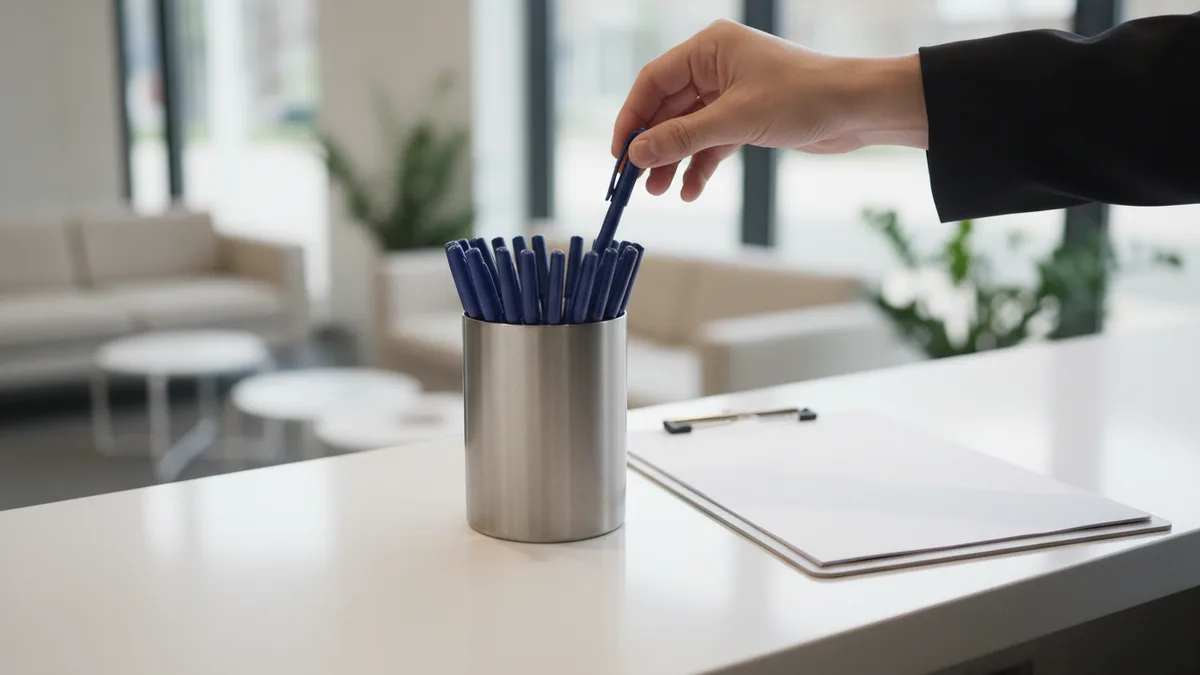
- Trade show: a click ballpoint. It is easy to hand out, there is no cap to lose, and it fits in a bag.
- Bank or credit union: a ballpoint or stylus pen for forms and signing tablets. A fine tip works for most customers.
- Clinic or medical office: a click pen with a grip, plus a stylus for check-in screens. Fast-drying ink keeps forms clean.
- School or university: a ballpoint or a gel pen, plus a highlighter for study. Bright barrels are easy to spot in a backpack.
- Hotel or restaurant: a slim, neat pen for the front desk and the check presenter. A metal pen reads as quality.
- Construction site or field work: a rugged click ballpoint and a permanent marker. Choose a pen that writes on rough, slightly damp surfaces.
Imprint Area and Barrel Shape
Look at where your logo will sit. A long, flat barrel gives a long logo room to breathe, while a round, slim barrel suits a short name or an icon. Metal pens can be engraved, and plastic pens are printed. A matte barrel hides fingerprints, and a glossy one makes colours pop. If you want to explore options, our metal pens are a good place to start for a premium look.
Black Ink or Blue Ink?
Black ink looks sharper and reads well on forms and scans. Blue ink stands out on a page, which makes signed originals easy to tell from copies. If you are not sure, black is the safer default for a general audience, and blue is a good fit for a bank or a legal office.
Writing Quality Beats Barrel Colour
The most common mistake with giveaway pens is picking on colour and ignoring how the pen writes. A pen that skips or smears goes in the bin, and your logo goes with it. A pen that writes well gets kept, and your name stays in a hand. We explain this in more detail in why your giveaway pens end up in the trash. Always test a sample pen before you order.
Six Questions to Ask Before You Order
- Who will use it, and where? A bag, a counter or a desk each want a different pen.
- What will they write on? Forms and receipts point to ballpoint, planners point to fine tip, boxes point to marker.
- Which mechanism fits? Click for crowds, twist or cap for gifts.
- How big is your logo? Check the imprint area before you fall for a barrel.
- Black or blue ink? Choose by audience, as above.
- Have you written with it? Ask for a sample and test the feel, the dry time and the grip.
A 60-Second Pen Test You Can Copy
Before any pen goes on an order, run it through this quick test. It takes a minute per sample and shows you what a spec sheet never will.
- Write your own name five times, then your logo line or tagline. Skipping or blobbing in the first minute is a bad sign.
- Draw a loop of continuous circles without lifting the pen. A good pen keeps flowing, and a weak one fades.
- Swipe a finger across the line after three seconds. Smudging tells you how it will treat a left-handed writer.
- Write on the paper your people use: a glossy receipt, a thin planner page, a form with a carbon copy.
- Hold it for two minutes while you write a paragraph. If your hand tires or the grip slips, so will theirs.
- Click it twenty times. The mechanism should feel crisp, not loose or noisy.
A Pen Brief You Can Paste Into Your Order Request
Copy this, fill in the blanks, and send it with your quote request so the pen fits the job the first time:
We are handing out pens to [audience] at [event or location]. People will mostly write on [forms, receipts, planners, tablets]. We want a [click ballpoint, gel, rollerball, stylus] with [black or blue] ink and a [fine or medium] tip. Our logo is [short text or icon], about [width] wide. Quantity: [number]. Needed by: [date].
Metal Pens and Pen Sets for Gifts
View all pen gift sets →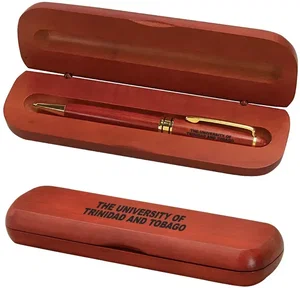
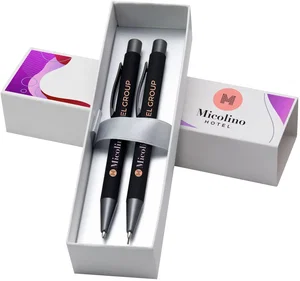
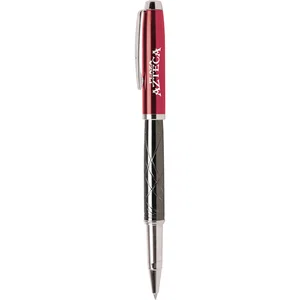
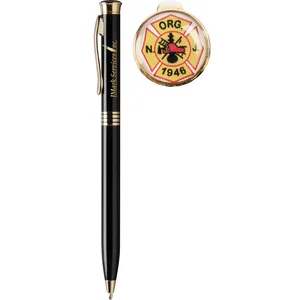
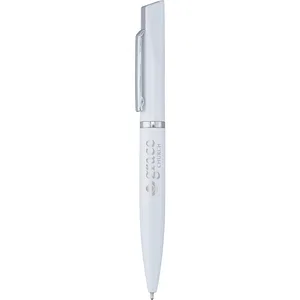
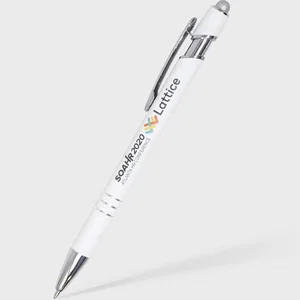
For a gift or a signing moment, a metal rollerball or a boxed set makes the right impression. See our pen gift sets for ideas.
Is Ballpoint or Gel Better?
Neither is better in every case: ballpoint is better for speed, durability and travel, and gel is better for smoothness and a bold line. If you hand out pens, a ballpoint is the safer pick. If you write a lot at a desk, try gel.
What Is the Smoothest Pen Type?
The smoothest pen type is a rollerball, followed closely by a gel pen. Both use water-based inks that flow with very little pressure. A fountain pen is also very smooth, but it needs more care. A ballpoint is the least smooth of the group, though newer low-viscosity inks have closed much of the gap.
What Are the Different Styles of Pens?
The different styles of pens are set by how they open and close: click, twist, cap and stick. Click pens are the best for giveaways, twist pens feel premium, capped pens protect the tip, and stick pens are simple and light. Beyond style, the types of pens for writing are ballpoint, gel, rollerball, fountain and felt tip, and these differ in ink and tip.
What Are the Top 5 Writing Pens?
The five kinds of pens worth owning are a fine ballpoint, a gel pen, a rollerball, a fineliner and a permanent marker. The ballpoint handles forms and travel, the gel handles everyday notes with a smooth line, the rollerball handles signing, the fineliner handles planners and small handwriting, and the marker handles everything that is not paper. Add a highlighter if you study, and a stylus pen if you live on a tablet.
What Pen Is Best for Left-Handed Writers?
A quick-drying ballpoint or fast-dry gel pen with a fine tip is best for left-handed writers. The ink sets quickly, so the hand does not smear the line. See the five tips above for grip and paper angle.
Which Pen Ink Lasts the Longest?
In general, oil-based ballpoint ink tends to keep writing the longest per refill. It is thick and flows slowly, so a small amount goes a long way. Gel and rollerball inks flow more freely, which feels smoother but uses ink faster. Ink life also depends on the pen's size, how hard you press and whether you keep the cap on, so treat this as a general rule, not a promise.
Ready to put your logo on the right pen? Tell us the job and we will help you pick.
Shop Related Categories
Related Articles

Hat Sizes: How to Measure Your Head, a Full Hat Size Chart and What OS Means
A plain-English guide to hat sizes: how to measure your head in one minute, a full hat size chart in inches and centimeters, what OS means on a size label, and how to size hats for a group.
T-Shirt Size Chart: How to Measure and How Many of Each Size to Order
A T-shirt size chart with real chest and length measurements for two blank tees, a two-minute way to measure a shirt, and a paper worksheet for how many of each size to order for a group.
Custom Keychain Ideas: Materials, Styles & Bulk Buying
Custom keychain ideas for bulk brand giveaways: compare metal, leather, acrylic and silicone, weigh engraving against printing, and learn the minimums, costs, and lead times for ordering branded keychains in volume.

Custom Lanyard Ideas: Materials, Clips & Bulk Buying
Custom lanyard ideas for conferences, schools, and staff IDs: compare polyester, nylon, and woven materials, standard widths, clips and ID holders, and how to order in bulk or with no minimum.