
The History of Promotional Products in America


In this guide, you'll trace the history of promotional products in America, from the very first branded keepsakes handed out by colonial-era figures to the multibillion-dollar advertising specialties industry of today. Along the way, you'll learn who invented promotional products, why calendars and pens became staples, and which classic giveaways still earn their keep in modern marketing. Whether you're a marketer curious about your craft's roots or a buyer deciding where to spend your next budget, this story explains why putting a logo on something useful has worked for more than two hundred years.
What Was the First Promotional Product?
Long before the term "advertising specialties" existed, people understood the power of giving someone a useful or memorable object tied to a name or cause. The commemorative buttons worn by supporters at George Washington's inauguration are commonly cited as the earliest American example. They weren't sold; they were distributed to mark a moment and rally enthusiasm, exactly the logic behind a modern conference giveaway.
What makes these buttons the "first" in spirit is the combination of three ingredients that still define every promotional product: a physical item, a printed message, and free distribution to keep a name top of mind. Take any of those away and you have something else entirely, a souvenir for sale or a paid advertisement. Put them together and you have the blueprint that an entire industry would later be built on. If you want the full modern definition, our explainer on what promotional products are breaks down the terminology in plain English.
George Washington and the Earliest Advertising Specialties
The decades after Washington's inauguration saw the idea spread organically. Politicians printed their names on ribbons and tokens. Shopkeepers gave regular customers small printed novelties. Almanacs carrying a merchant's name circulated through farming communities, often kept on the wall and consulted all year, an early lesson in how repeated exposure beats a one-time impression.
These early items shared a humble, hand-crafted quality because mass production hadn't yet arrived. That changed as printing technology improved and the country industrialized. By the late 19th century, a business no longer had to commission a custom keepsake one at a time. It could order printed goods in volume, and that shift is what turned a scattered practice into a genuine commercial category.

The Birth of the Promotional Products Industry
The widely told origin story belongs to Jasper Meeks of Coshocton, Ohio, who in the 1880s persuaded a local shoe store to put its name on book bags given to schoolchildren. Other printers in the same town followed, and Coshocton became an early hub for what we now call advertising specialties. Soon salespeople were carrying sample cases of imprintable goods, from calendars and fans to rulers and matchbooks, calling on businesses across the country.
This commercialization created the need for shared standards, and trade associations followed. The organizations known today as PPAI (the Promotional Products Association International) and ASI (the Advertising Specialty Institute) emerged in the first half of the 20th century to connect suppliers, distributors, and buyers. Their formation marked the moment promotional products stopped being a clever local tactic and became a recognized national industry with its own marketplace, terminology, and best practices.
How Calendars, Pens, and Apparel Became Staples
Not every object makes a good promotional product. The items that endured did so because they nailed the same formula every time: they solved a small everyday problem while keeping a brand in view.
| Staple | Why it stuck |
|---|---|
| Calendars | Displayed for an entire year in homes and offices, delivering daily repeat exposure |
| Pens | Inexpensive, used constantly, and frequently borrowed, spreading a logo person to person |
| Apparel | Worn in public, turning recipients into mobile advertisements and signaling belonging |
| Bags | Reused for shopping and travel, carrying a brand across a wide range of settings |
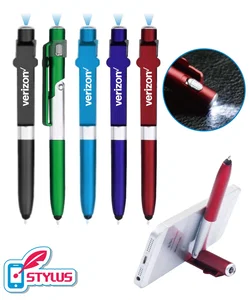
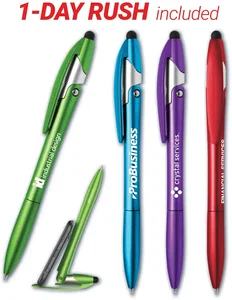
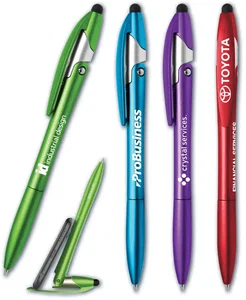
Advertising calendars were among the earliest mass-produced specialties precisely because of their shelf life, a single imprint earned twelve months of attention. Writing instruments rose alongside them; a branded pen is cheap to produce, genuinely useful, and travels effortlessly from desk to pocket to a borrower's hand. That same logic makes promotional pens and writing instruments one of the highest-volume categories to this day.
Apparel completed the trio. Once decoration methods like screen printing and, later, embroidery became affordable, a shirt or cap could carry a logo into the world far beyond the office. The trade show floor became the natural showcase for all three, a dynamic our trade show swag guide covers in depth. You can see the modern range of wearables on our promotional apparel and bags and totes pages.
Shop Classic Promotional Pens
View all →
Promotional Products in the Digital and Sustainable Era
As personal technology became part of daily life, the industry adapted. USB drives, phone accessories, wireless chargers, and Bluetooth speakers earned a place in the catalog because they offered the same practical, high-visibility appeal as a pen, just for a digital age. A useful gadget on someone's desk earns the same repeated glances that an advertising calendar earned a century earlier.
The bigger shift has been environmental. Buyers and recipients increasingly judge a giveaway by its footprint, not just its logo. That has driven strong demand for products made from recycled plastics, organic cotton, bamboo, and other renewable materials, along with reusable items like water bottles and totes that replace single-use alternatives. Many of the recycled and cotton tote bags popular today exist because of this expectation. The throughline is unchanged: give people something they'll actually keep and use. What's evolved is the standard for what "useful" and "responsible" now mean.
The Classics That Are Still Bestsellers Today
For all the innovation, the products that launched the industry are still the ones that move in the largest volumes. There's a simple reason: the math that worked in 1900 still works now. A pen costs little, gets used constantly, and travels freely between people. Apparel turns a single recipient into ongoing public exposure. A reusable bag accompanies someone through grocery runs, gym visits, and travel.
Industry research repeatedly confirms this. ASI's long-running studies on advertising specialties have found that recipients tend to keep practical items for months and can often recall the advertiser, with wearables and writing instruments scoring especially well on retention and recall. That durability of attention, not novelty, is what makes the classics dependable. For a closer look at the real-world problems these items solve, see our guide to the marketing challenges promotional products solve, and for a deeper case study in how a single classic product carries a brand, read the history of promotional yardsticks.
The lesson of two centuries is reassuring for any buyer: you don't need a gimmick to make an impression. You need something people genuinely want to use, with your name on it.
Ready to put your logo on a classic that still works?
Frequently Asked Questions
Who invented promotional products? No single person invented them, but printer Jasper Meeks of Coshocton, Ohio is widely credited with one of the first commercial advertising specialty deals in the 1880s. The broader practice predates him, with George Washington's 1789 inaugural buttons cited as the earliest famous American example.
What was the first promotional product? The commemorative buttons distributed at George Washington's 1789 presidential inauguration are commonly regarded as the first American promotional product, since they combined a physical item, a printed message, and free distribution.
When did the promotional products industry begin? The industry as a commercial category took shape in the late 1800s and was formalized in the early 20th century with the founding of the trade associations now known as PPAI and ASI.
Why are pens and calendars still so popular? They offer the best ratio of cost to exposure. A calendar earns a full year of daily views, and a pen is cheap, constantly used, and frequently shared, so both keep a brand visible far longer than the price suggests.
Shop Related Categories
Related Articles

Do Promotional Products Work? What the ROI Data Shows
Do promotional products actually work, or do they just end up in a drawer? We break down the recall, retention, and ROI data so you can decide where branded merch fits in your marketing budget.

Promotional Products vs. Corporate Gifts vs. Branded Merchandise
Promotional products, branded merchandise, and corporate gifts overlap so much that buyers use the terms interchangeably — but choosing the right one changes your budget, quantity, and results.

Promotional Product Production Time: What Every Buyer Needs to Know Before Ordering
If you've ever placed an order for branded merchandise and wondered whether it would arrive before your event, you already understand why promotional product production time matters.

The Complete Guide to Pink Awareness Ribbons
When you see someone wearing a pink ribbon, what immediately comes to mind? For most people, it's breast cancer awareness. But here's what many don't realize—the pink awareness ribbon represents far more than just one cause.