
How Car Air Fresheners Are Made: The Complete Manufacturing Process




A good car air freshener keeps your vehicle smelling fresh for weeks and masks everything from coffee spills to gym bags. Buy the wrong one, though, and you're stuck with either no scent after a few days or something so strong it gives you a headache on every commute.
The difference between a good freshener and a poor one comes down to how car air fresheners are made: the materials, the fragrance and the manufacturing steps most people never think about.
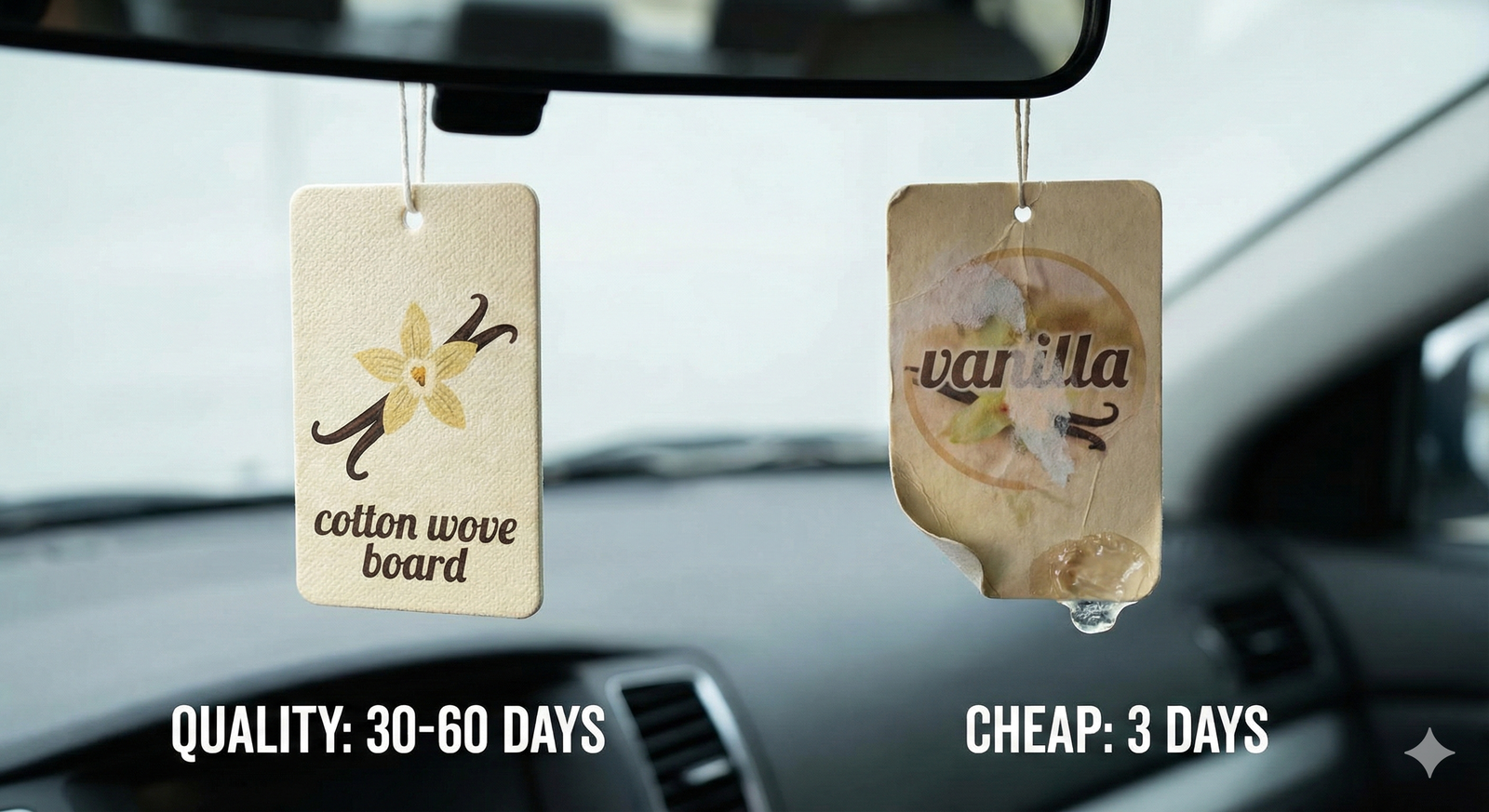
The good ones use cotton wove board that absorbs more fragrance than regular cardboard, well-made fragrance oils that actually smell like what they claim, and printing that won't fade or peel when your car sits in summer sun. The cheap ones cut every corner: basic cardboard that can't hold scent, fragrances that smell nothing like the label, and printing that starts peeling before you open the package. Understanding the actual car air freshener manufacturing process changes how you shop for these things.
Custom Car Air Fresheners
View all air fresheners →


What Are Car Air Fresheners Made Of?
The base material is the single biggest factor in quality. Most cheap fresheners use plain cardboard, which can't hold much oil and dries out fast. Better custom air fresheners use cotton wove board because its fibrous, absorbent structure holds far more fragrance oil and doesn't take on a "wet" look when saturated. It also releases scent gradually over weeks instead of dumping it all at once.
So the full "ingredient list" of a typical paper car air freshener is short: porous paperboard, fragrance oil, a carrier solvent, ink, and a string. The differences between a freshener that lasts a week and one that lasts for weeks come almost entirely from the grade of the board and the quality of the oil, not the tree shape on the front.
Many producers now offer eco-friendly versions, with recyclable paperboard containing post-consumer waste and water-based inks becoming common across the industry.
How Do Car Air Fresheners Work?
There's no battery, fan, or chemical reaction in a basic hanging freshener. The carrier solvent (commonly hexylene glycol) is what makes the release gradual: it slows how fast the oil evaporates so the freshener lasts weeks instead of hours. Some fresheners add micro-encapsulation, which traps fragrance in tiny capsules that rupture over time for a steadier scent. Vent-clip versions sit in the airflow from your dashboard vents, so the moving air carries the scent through the cabin faster.
How Are Car Air Fresheners Made? (The 5-Step Process)
The rest of this guide walks through each stage in detail, from raw paperboard to the sealed package you tear open in your car.
Step 1: Why Does the Base Material Matter?
The base material decides how much fragrance a freshener can hold and how slowly it lets go. Most low-cost manufacturers use basic cardboard, and that's where problems start. Cotton wove board absorbs noticeably more fragrance than ordinary cardboard while keeping its shape, which is why it's become the industry's standard for paper fresheners.
Cotton wove board also avoids the "wet" appearance cardboard gets when soaked with fragrance oil, and it releases scent gradually rather than all at once. Manufacturers who pay more for this board get a noticeably better finished product.
If you're sourcing air fresheners as a branded giveaway, a tactic we cover in our roundup of promotional items every car dealership needs, the board grade is worth asking about directly. It's the difference between a customer who keeps your logo hanging for weeks and one who tosses it after a week.
Step 2: How Is the Fragrance Added?
Fragrance is added by soaking the printed board in a blend of fragrance oil and a carrier, or by printing or coating it with fragrance. The carrier, often hexylene glycol, helps the scent soak in evenly and evaporate slowly. Perfumers balance top notes, middle notes and base notes so a scent still smells right as it fades.
Fragrance choice can make or break a promotional freshener. Perennially popular profiles include New Car (a crisp blend of citrus and musk), Alpine Fresh with water lily and cedarwood notes, and Forest, which combines pine needles with a hint of mint. Good manufacturers test each fragrance to make sure it keeps its character as it fades.
Manufacturers typically use one of three infusion methods: soaking, where board pieces sit in sealed containers of fragrance solution; gravure printing with fragrance-infused ink; or micro-encapsulation, which places tiny fragrance capsules on the surface. Soaking remains the most common because it spreads the oil most evenly.
Step 3: How Are Designs Printed on Air Fresheners?
Designs are printed onto the board before the fragrance goes on, so the oils don't damage the ink. Screen printing is still used for simple designs, but digital printing is common because it handles photographic images and fine detail that screen printing can't match.
Many printers use fade-resistant inks so the design holds up in sunlight through your windshield. A white ink underlayer also helps: it creates a bright base that makes colors stand out against the slightly off-white board.
For print preparation, artwork should ideally be vector-based, saved as EPS or AI files, and photographic images should be at least 300 DPI to avoid pixelation. Double-sided printing is widely available, which is useful for promotional fresheners where you want branding on one side and a message or offer on the other.
Step 4: How Are Air Fresheners Cut Into Shapes?
Air fresheners are cut into shapes with custom steel dies on industrial presses. Die cutting is the industry standard because it produces clean, uniform edges every time, and a custom die can make almost any outline: traditional trees, company logos, mascots or product silhouettes.
Automated die cutting lines run quickly on large orders. Laser cutting is an alternative for small batches or prototypes, though it's slower on large production runs.
Quality control at this stage matters. Operators check cuts for smoothness and accuracy and remove pieces with rough edges or misalignment. Even small flaws can affect how the freshener hangs and how customers judge the product.
Step 5: How Is the String Attached?
The elastic string is threaded through a punched hole and knotted, by hand on small runs or by machine on larger orders. Many manufacturers offer a range of string colors to match brand colors or the design.
String quality matters more than you'd expect. Cheap elastic snaps or goes slack in heat. Better manufacturers use heat- and sun-resistant elastic that keeps its stretch for the life of the freshener, and they test knot strength so the freshener doesn't drop off mid-drive.
Step 6: How Are Air Fresheners Packaged to Keep Their Scent?
Each freshener is sealed in its own barrier film pouch, which keeps the fragrance from evaporating before the customer opens it. Most manufacturers use barrier-coated polyester film that creates an airtight seal, so the scent stays fresh in storage.
Heat-sealing machines create three-sided pouches, leaving one edge open. After the freshener goes in (often by automated pick-and-place systems), the final edge is sealed. Many packages include tear notches so the pouch is easy to open.
For retail-ready products, header cards or backer cards are added during packaging. These carry branding, usage instructions and any required safety warnings. Finished packages are checked for seal integrity, print alignment and overall presentation, and damaged or poorly sealed packages are pulled from the line.
How Do Manufacturers Check Quality?
Manufacturers check quality at every stage, from raw board to the sealed pouch. Board is tested for absorption and strength. Fragrance batches can be checked by gas chromatography to confirm their composition. Printed pieces are matched against Pantone colors, and finished packages are spot-checked for scent strength and seal integrity.
Many facilities track defect rates and production speeds to find problems early, and some hold ISO 9001 certification for their quality management systems.
What Does It Cost to Manufacture Car Air Fresheners?
It depends almost entirely on volume and automation. If you're researching the business side (searches like "car air freshener manufacturing plant cost" and "industrial car air fresheners" are common), a small print-on-demand setup with die-cut blanks, a digital printer and hand stringing costs far less than a fully automated line with high-speed presses, fragrance-soaking tanks, automated stringing and heat-sealing packagers.
For most businesses, though, manufacturing your own doesn't make sense. Buying custom-printed air fresheners in bulk from an established producer gets you industrial quality without the equipment, tooling or fragrance-handling overhead. That's the route nearly every brand and dealership takes, and our marketing guide to custom air fresheners for cars walks through how to put those bulk-ordered fresheners to work.
Are Hidden and Vent-Clip Fresheners Made Differently?
Mostly no: the chemistry is the same fragrance oil plus a slow-evaporating carrier, but the housing changes. "Hidden" under-seat or cup-holder fresheners use a vented plastic shell or gel cartridge instead of exposed paperboard, so the scent spreads without a visible hanging card. Vent-clip versions hold a fragrance pad or gel in a clip that sits in your dashboard airflow, using moving air to push scent through the cabin faster than a hanging tree. Only the molded housing and assembly stage differ; the fragrance formulation stays the same.
Are Car Air Fresheners Made More Sustainably Now?
Yes, many manufacturers have moved to cleaner materials and processes. Water-based inks have replaced solvent-based inks in many facilities, many fragrance formulations now avoid phthalates, and some companies have switched to biodegradable films or smaller packaging.
Emissions matter here too. The U.S. EPA lists air fresheners among the household products that emit VOCs and notes that "concentrations of many VOCs are consistently higher indoors (up to ten times higher) than outdoors." That's one reason manufacturers keep reformulating, and a good reason to keep a car window cracked when a new freshener is at its strongest.
On the production floor, nesting software arranges shapes on each sheet to cut material waste, and some facilities recycle their paper scrap.
What's Next for Car Air Fresheners?
The next changes are mostly in scent delivery and customization. Micro-encapsulation allows time-release fragrances that hold a steadier scent level. Some products add app-connected controls for intensity or replacement reminders, and a few print QR codes that link to promotions.
Customization keeps expanding too. Variable data printing lets each freshener in a batch carry unique elements such as names or serial numbers, which opens new uses for promotional products and personalized gifts.
How Long Does It Take to Make Custom Air Fresheners?
Custom orders take longer than stock designs because each stage has to be coordinated: design approval, printing, fragrance application, cutting, stringing and packaging. Standard designs can move faster through pre-printed inventory. Ask for a production timeline when you order so the fresheners arrive before your event or campaign.
Because they're inexpensive to print, light to ship and used every day, custom air fresheners earn a spot on most lists of effective branded merchandise, from our guide to promotional gift ideas for business to our picks for the best promotional items for small business. They pair naturally with other in-car branded products too: the kind of parking permits and hang tags a campus issues hang from the same rearview mirror. Our custom paper air freshener is a flagship option, while the aRoma Ball gives you a refillable bead-style alternative.
Frequently asked questions
What are car air fresheners made of?
Most paper car air fresheners are made of cotton wove board soaked in fragrance oil and a slow-evaporating carrier such as hexylene glycol. They are printed with ink and hung on an elastic string. Gel and vent-clip styles use a scented gel or pad in a plastic housing instead.
How long does a car air freshener last?
A paper car air freshener usually lasts a few weeks, depending on the board, the fragrance oil, heat and airflow. Scent is strongest right after you open the pouch and fades gradually. Opening the pouch a little at a time can stretch its life.
Why does a car air freshener smell so strong at first?
The fragrance evaporates fastest when the board is fully saturated and first exposed to air. As the oil level drops, evaporation slows and the scent softens. Heat inside a parked car also speeds up the release.
Can you put a logo on a car air freshener?
Yes, custom car air fresheners are printed with your logo or artwork before the fragrance is added. You can choose a standard shape or a custom die-cut outline, and many styles print on both sides. Browse custom air fresheners to see the options.
Are car air fresheners safe to use?
Car air fresheners release fragrance chemicals, including VOCs, into the cabin air. The U.S. EPA lists air fresheners among household products that emit VOCs, so follow the package directions and ventilate the car if the scent feels too strong.
Put your logo on a scent people keep in the car
Ready to create your own custom car air fresheners? Browse our selection of promotional auto products and see how a well-made freshener can keep your brand in front of drivers every day. From custom shapes to signature scents, we'll guide you through every step.
Shop Related Categories
Share this post with your team
Send it to a colleague or save it for later.
Related Articles

Advertising Air Fresheners: A Guide for Auto Businesses
Advertising air fresheners keep your logo in the car for weeks at a low cost per piece. Here is how to choose shapes, scents, and formats, and how to order in bulk.
Car Magnet Advertising: How It Works and How to Buy
Car magnet advertising turns any vehicle into a moving sign without touching the paint. Here is how to pick the right thickness, size, and design so your brand gets noticed on the road.
Emergency Kit List for Car: What to Keep in Your Trunk
A dead battery on a dark shoulder is no time to discover your trunk is empty. This emergency kit list for car owners covers what to carry, what to add for winter, and how to keep it ready.

7 Must-Have Promotional Items Every Car Dealership Needs to Boost Sales
You've closed the sale. The customer drives off the lot excited about their new vehicle. Then what? Most dealerships lose momentum right here.