
How to Choose a Promotional Products Company (Buyer's Guide)


What a promotional products company actually does (distributor vs. supplier)
When you start shopping for custom pens or branded apparel, you'll see the words "supplier," "distributor," "vendor," and "broker" used loosely. The distinction matters because it tells you who is accountable when something goes wrong. The distributor is your single point of contact: they take your logo, generate a proof, place the order with the right factory, ride the production timeline, and own the result. A good one acts like an extension of your marketing team rather than an order-taker.
That accountability is the whole reason a small business benefits from a promotional products company instead of trying to buy blanks and decorate them piecemeal. For a broader primer on the category before you buy, our overview of what promotional products are and how they work is a good starting point, and if you're still weighing whether to invest at all, see why custom promotional products are essential for small business success.
7 questions to ask before you order custom promo products
The questions you ask up front separate a reliable partner from a headache. Run any prospective vendor through this list:
- Is your quote all-in? Confirm whether the price includes setup/screen charges, art fees, and shipping—or whether those land later as surprises.
- What's the minimum order quantity for this item? MOQs differ by product and by decoration method (embroidery often has higher minimums than screen printing).
- Will I get a digital proof and a physical sample? You should see exactly how your logo sits on the product before a full run is decorated.
- Which decoration method do you recommend, and why? Screen print, embroidery, laser engraving, and full-color digital each suit different products and budgets.
- What's your standard turnaround, and do you offer rush? Get the date in writing, and ask what a rush costs.
- Can you show me recent work for businesses like mine? Real examples beat a generic catalog.
- What's your policy if the order is wrong or defective? A trustworthy company reprints or refunds genuine errors without a fight.
If a salesperson gets cagey on questions 1, 3, or 7, treat that as information. For inspiration on what to actually order once you've vetted the company, our 2025 best picks for small businesses breaks down high-ROI categories.
How to compare pricing, setup fees, and minimum order quantities
Promotional pricing is built on quantity breaks: the more you order, the lower the per-piece cost, because fixed costs like screen setup spread across more units. That's why a 250-piece order can feel expensive per item while a 1,000-piece order feels like a steal. Here's how the common cost components stack up:
| Cost component | What it covers | Typically charged |
|---|---|---|
| Item / unit price | The product itself, at your quantity tier | Per piece |
| Setup / screen / die | Preparing the decoration for your logo | Once per color or location |
| Art / proof fee | Creating or cleaning up your artwork | Once (often waived) |
| Shipping & freight | Getting the goods to you | Per order |
| Rush charge | Compressing the production timeline | Optional |
Minimum order quantities are the other half of the equation. A low MOQ (say, a dozen) lets you test a new product or run a small event without overcommitting; a higher MOQ pushes you into better price breaks but ties up budget. Decoration method drives MOQ too—embroidered apparel and certain imported items often carry higher minimums than screen-printed bags or laser-engraved drinkware. When you compare companies, normalize everything to a true cost per piece at the quantity you'll actually order. For help right-sizing the spend itself, our guide to bottom-up vs. top-down budgeting for promotional marketing is worth a read.
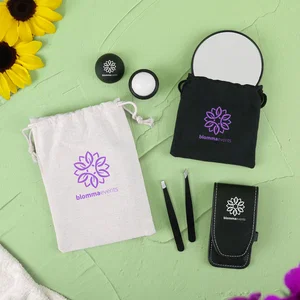
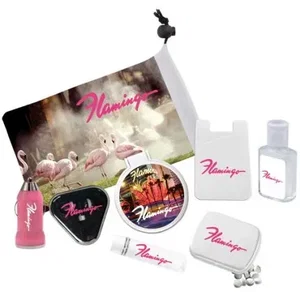
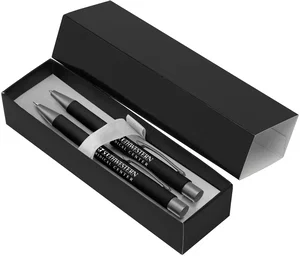
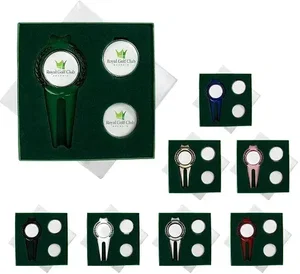
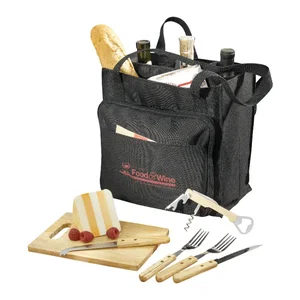
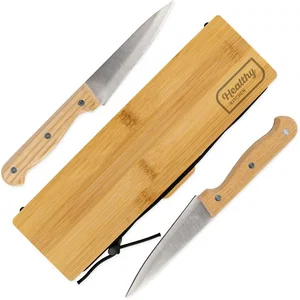
Shop popular promotional gift sets
View all →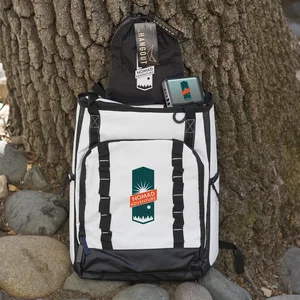
Proofs, samples, and turnaround: what good vendors guarantee
The proof is your insurance policy. Before a single unit gets decorated, a good company sends a digital mockup showing your logo at the exact size, color, and placement it will print. You review it, request changes, and sign off. Skipping the proof is how businesses end up with a pixelated logo on 500 shirts—and it's the single most preventable mistake in this industry.
A physical sample goes a step further. For apparel especially, ask to see and feel the blank before you commit; a "soft, premium tee" in a catalog photo can arrive stiff and boxy. Reputable companies will send a sample (sometimes for a refundable fee) precisely because they know it closes confident buyers. When you're choosing decorated apparel, our promotional apparel category shows the range of garment styles and fits worth sampling, and a writing instrument like the Aidan Bamboo Stylus Pen is the kind of low-cost item where a sample quickly confirms quality.
On turnaround, standard production typically runs one to three weeks plus shipping, depending on the product and decoration. What matters is that the company commits to a date in writing and is honest about rush capability. If you're ordering for a fixed deadline—a conference, a product launch, a grand opening—say so up front. For event-driven orders specifically, the trade show swag ultimate guide covers lead times and quantities in depth.
Red flags that signal a low-quality promo products supplier
Most promo disasters trace back to warning signs that were visible before the order shipped. Watch for these:
- Opaque pricing. If you can't get a clear, all-in number, you'll likely get surprise charges later.
- No proof, no sample. A vendor who wants you to approve "blind" is gambling with your money.
- Vague timelines. "Should be a couple weeks" is not a commitment. Get a date.
- Unreachable service. If it's hard to reach a human before you've paid, it'll be impossible after.
- No references or recent work. Established companies can show what they've produced for businesses like yours.
- Pressure to overbuy. A good partner right-sizes your order; a bad one pushes the biggest quantity.
- Sloppy artwork handling. If they don't ask about file formats, logo colors, or vector art, expect quality problems.
Quality and price aren't the same axis. The cheapest quote attached to most of these red flags is the most expensive order you'll ever place—because you'll likely reprint it. A reliable company costs a little more on paper and saves you the reorder. And once the order lands, knowing how to measure promotional product ROI tells you whether that spend actually paid off.
Checklist: choosing the right promotional products company for your small business
Use this as your final scorecard before you commit:
- ✅ Transparent, all-in pricing with setup, art, and shipping spelled out
- ✅ MOQ confirmed for the exact product and decoration you want
- ✅ Digital proof + physical sample offered before production
- ✅ Turnaround date in writing, with a stated rush option
- ✅ A real, reachable point of contact
- ✅ Recent work or references for businesses like yours
- ✅ A reprint or satisfaction guarantee on genuine errors
- ✅ Catalog breadth—pens, apparel, drinkware, and curated gift sets—so one trusted partner covers most needs
The best company for promotional products is rarely the one with the lowest line-item price. It's the one that catches a logo problem on the proof, hits your deadline, and answers the phone when you call. Once you've found that partner, the fun part begins—choosing products that fit your audience, from a durable everyday item like a cotton canvas tote to a polished bamboo stainless steel tumbler gift set for clients and VIPs. For more product ideas to test first, our promotional pens collection is the classic low-risk starting point.
Ready to work with a promotional products company that puts it in writing?
Related Articles
Employee Welcome Kit Ideas for Small Businesses (That New Hires Keep)
A practical guide to employee welcome kit ideas for small businesses—what to include, ideas by budget, remote vs. in-office kits, and how to assemble and ship them without an in-house team.

How to Measure Promotional Product ROI (Without Guessing)
Promotional products feel hard to measure—but they don't have to be. This guide shows you the exact formulas, tracking setup, and worksheet to prove the ROI on your next branded order.

Is Company Swag Taxable? Your Complete Guide to Avoiding Tax Headaches
You ordered branded merchandise for your team or clients, and now tax season has you wondering: is company swag taxable?

25 Promotional Materials Examples for Modern Marketing Campaigns
25 promotional materials examples for modern marketing campaigns, organized by category, with real cost-per-impression data and a simple framework for matching each item to your audience and goal.