
41 Trade Show Swag Ideas (and Giveaways) People Actually Keep


Walk a convention hotel's hallway the morning after a show and you'll see the truth about most trade show swag: a housekeeping cart stacked with stress balls, foam koozies, and totes nobody wanted badly enough to pack. That's where the average giveaway budget ends up: in a bin, before the flight home.
A few exhibitors get a different result. Their item survives the packing purge, rides home in a carry-on, and gets used at a desk in Ohio eight months later, still doing its job. The gap between those two outcomes has almost nothing to do with how much was spent. It's whether anyone thought about the giveaway before ordering it.
This guide covers what that thinking looks like: 41 trade show swag and giveaway ideas worth bringing in 2026, what to spend per item, how many to order, how to hand them out so they don't just feed freebie hunters, and how to prove afterward that any of it worked.
Popular Trade Show Giveaways
View all →
What Is Trade Show Swag?
Swag and trade show giveaways are the same thing wearing two different names: one's the term people use in conversation, the other's what shows up in a marketing budget line. If you're new to the category, our explainer on what promotional products are and how they work covers the fundamentals. At an event, a giveaway does four jobs at once, whether or not the person handing it out realizes it. Brand awareness: your logo travels home in someone's bag and sits on a desk for months. Lead generation: a giveaway worth having gives a stranger a reason to stop walking and let you scan their badge. Relationship building: a genuinely useful item buys goodwill before a sales conversation ever starts. Extended reach: every time it's used in public after the show, it's advertising to people who were never on the floor.
The broader category of trade show and expo products also covers banners, table covers, badge holders, and booth displays, worth planning alongside your giveaways so the booth and the handouts tell the same visual story instead of fighting each other.
Why Swag Works (the Numbers Behind the Hunch)
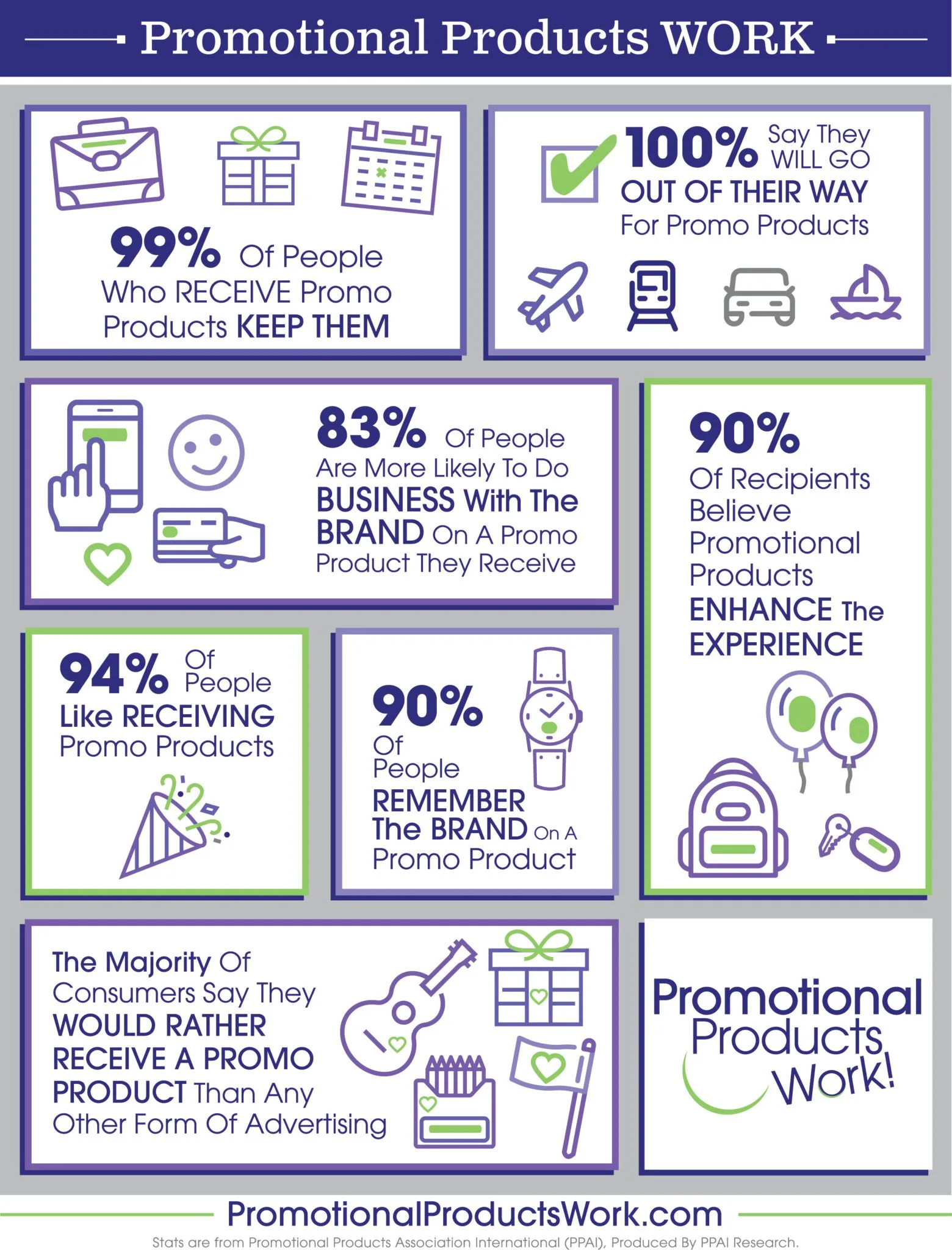
Every marketer has a gut feeling that swag "works." Here's what backs it up:
- People remember who gave it to them. PPAI's consumer research has consistently found that roughly eight in ten people can name the advertiser on a promotional item they've received.
- It doesn't disappear after the show. ASI's Ad Impressions Study puts the average holding period for a promotional product at around eight months: eight months of repeat exposure from one handout.
- A single tote outperforms most digital ads. That same ASI research found one promotional bag generates over 3,000 impressions across its lifetime in the U.S., which is exactly why every competitor's booth still has one.
- The room is worth talking to. Per the Center for Exhibition Industry Research (CEIR), more than 80% of trade show attendees have buying authority. Nobody wandering the floor is there by accident.
- Some items keep working after everyone's gone home. Promotional air fresheners are flat, individually wrapped, cheap to mail in a follow-up, and good for 30-60 days of daily exposure once someone hangs one in a car.
Two psychology principles do most of the heavy lifting. Reciprocity: give someone something of real value and they feel a small, automatic pull to give something back, whether that's five minutes for a demo or their contact details. The endowment effect: the moment an item is in someone's hand, they value it more than they did a second earlier, and a well-made item quietly transfers a little of that value onto your brand.
41 Trade Show Swag Ideas and Giveaways for 2026
The best trade show swag is the kind attendees would be mildly annoyed to lose: portable, genuinely useful past the show floor, and branded clearly enough to be recognized without looking like a moving billboard. Here's the full list, grouped by category, in the order most booths should be stocking them.
Tech Swag (1-7)
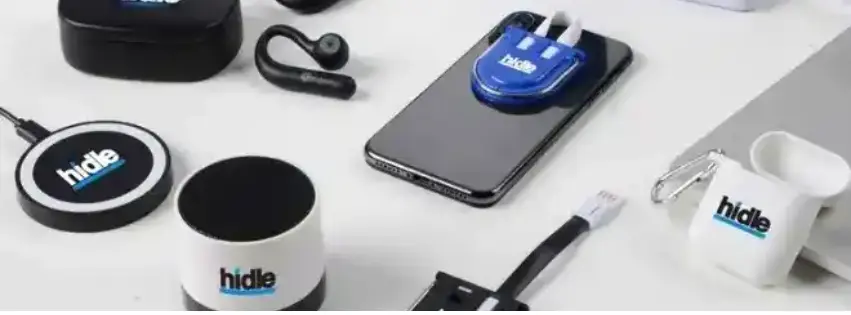
Custom tech giveaways win because everyone on the floor is running on a dying battery by 2 p.m. A 10000 mAh power bank holds multiple full phone charges and gets used for years, not days: the rare giveaway that's still in someone's bag a year later.
- Portable power banks and wireless chargers: go higher-capacity and fast-charging; the cheap ones get one use and get tossed.
- Noise-cancelling wireless earbuds: reads as a genuine gift to a traveling professional, not a giveaway.
- Phone grips and stands: constant, eye-level logo real estate every time they check a message.
- USB-C hubs and cable organizers: solves an everyday desk problem nobody's fixed for themselves yet.
- Webcam covers: cheap, flat to ship, relevant to literally anyone who takes video calls.
- Portable UV phone sanitizers: a post-2020 category that stuck around because it's genuinely used.
- Mini Bluetooth speakers: save these for the qualified tier; nobody expects to walk away with one, which is exactly why it works.
For a startup or developer audience, see our roundup of smart tech swag ideas for growing companies. For the item you mail to hot leads after the show, best branded tech gifts for employees and clients covers the picks worth reserving for your top prospects.
Eco-Friendly Swag (8-13)
Sustainability stopped being a differentiator a while ago. It's baseline now. Wasteful swag actively costs you goodwill with an environmentally conscious visitor, which by 2026 is most of them.
- Cotton canvas convention totes: like this 100% 4oz cotton canvas convention tote, which ends up carrying every other giveaway on the floor with your logo at eye level all day.
- Seed paper cards or wildflower seed packets: grow into something instead of landfill.
- Bamboo cutlery sets: signals the value without a lecture attached.
- Recycled-material notebooks and pens: same utility, better story.
- Solar phone chargers: the tech and eco categories in one item.
- Reusable snack or produce bags: small, cheap, and it's the rare giveaway someone actively looks for a use for that week.
Wearables (14-19)
- Custom crew socks: the closest thing this industry has to a cult item; people photograph the good ones and post them.
- Branded sunglasses: cheap, visible, and made for outdoor or warm-climate shows.
- Lapel pins: reserve for VIPs, speakers, or long-time customers; scarcity is the point.
- Touch-screen gloves and beanies: the right call for fall and winter show seasons.
- Structured baseball caps: walks around the show floor advertising for you all day.
- Packable rain ponchos: nobody plans for weather at an outdoor expo until they need one badly.
Office and Desk Items (20-25)
- Wireless charging mousepads: merges two things already on every desk into one branded surface.
- A pen that actually writes well: sounds small, but it's still the most-used item at the show itself.
- Desk organizers: stays in the sightline for a full workday, every workday.
- Ergonomic wrist rests: solves a real complaint most people haven't gotten around to fixing.
- Cable-management clips: a dollar item that quietly earns its keep for years.
- Dry-erase desk pads: functional enough to survive a desk reshuffle.
Health and Wellness (26-31)
- Lip balm: tiny, cheap, used within the hour.
- Hand sanitizer: same, and never goes out of relevance at a show.
- Mineral sunscreen sticks: genuinely useful at any outdoor activation.
- Insulated water bottles: solves a real show-floor problem and lives on the desk for months after.
- Compact first-aid kits: signals practical care instead of another pen in the pile.
- Stress relievers shaped to the industry: a $100 bill stack stress reliever for a finance brand is a cheap conversation starter that also does the work of echoing what you sell.
Food and Drink (32-36)
- Reusable coffee sleeves: functional at literally every show that serves coffee, which is all of them.
- Local snack packs: a small, easy way to differentiate from the candy bowl every other booth has.
- Coffee sample sachets: cheap, shippable, and gives someone a reason to think of you at 7 a.m. next week.
- Electrolyte drink mix sticks: like Gatorade electrolyte drink mix packets, a genuinely useful item for anyone spending eight hours on a concrete floor.
- Mint tins: small enough to survive airport security and a carry-on, which is most of the battle.
Experiential and On-Site Swag (37-41)
Not everything worth giving away is an object. The booths that draw a crowd in 2026 increasingly turn the giveaway into something that happens, instead of something merely handed over.
- On-site engraving or heat-press personalization: putting someone's name on an item in front of them creates both a line at your booth and an item nobody throws away.
- A spin-to-win prize wheel: turns handing out swag into booth theater that pulls people in from three aisles over.
- A sock or shoe "build bar": pick the colors and patches, walk away wearing it; this is a giveaway and a ten-minute conversation at the same time.
- A professional headshot station: costs more to set up than a pen, but it's the kind of giveaway someone actually posts to LinkedIn with your booth backdrop in frame.
- A phone-charging lounge: solve the dead-battery problem with seating and a branded backdrop instead of a handout, and you've built a reason to linger.
How Much Should You Spend on Trade Show Giveaways?
A practical three-tier structure:
| Tier | Cost per item | Who gets it | Examples |
|---|---|---|---|
| Mass | Under $3 | Anyone who stops | Pens, lip balm, mint tins, stickers |
| Engaged | $3–$10 | Demo viewers, badge scans | Totes, water bottles, socks |
| Qualified | $10–$50+ | Booked meetings, hot leads | Power banks, drinkware sets, apparel |
Tiering beats a flat budget for a simple reason: it stops you subsidizing swag collectors. Someone who grabs everything on the table gets the $1 pen, not the $20 power bank, and the premium items become a genuine sales tool ("sit through a ten-minute demo and it's yours" reliably converts foot traffic into a real conversation). Cost per qualified lead drops even when total spend doesn't move at all.
Quality still beats quantity inside every tier. A hundred items people actually keep outperforms a thousand that get left on a chair. If budget is the binding constraint, our guide to proven promotional items for small businesses covers picks with real impact at a low unit cost.
How Many Trade Show Giveaways Should You Order?
Adjust that starting formula for booth location and size, show length, and your draw. A high-traffic corner booth burns through inventory far faster than a back-row spot. Multi-day shows need a rationing plan, or day three arrives with nothing left to hand out. A demo, contest, or charging lounge pulls more visitors than a bowl of candy ever will.
Order early. Custom production and shipping timelines vary a lot by product and decoration method. Our promotional product production time guide breaks down realistic timelines so you're not paying rush fees the week before the show.
How to Choose the Right Swag: 5 Criteria
Run every item you're considering through these five filters before you order it:
- Audience fit. Would this specific buyer use it weekly? IT directors, nurses, and contractors do not want the same item.
- Usefulness after the show. Items that solve an everyday problem survive the post-trip purge; novelties almost never do.
- The carry-on test. Attendees fly home. Flat, light, and unbreakable wins. Bulky and fragile gets left in the hotel room.
- Brand alignment. A software company handing out flimsy plastic trinkets sends a message it didn't intend to send. Quality is part of the pitch.
- Imprint real estate. Put your logo where it'll actually be seen during use, and keep the design clean rather than covering every inch of the item.
Trade Show Giveaway Distribution Strategy
How you hand out swag matters as much as what you're handing out:
- Gate the good stuff. Tie mid- and premium-tier items to an action (a demo, a survey, a badge scan, a booked meeting).
- Put a QR code on it. Print one on the item or its packaging, linking to a landing page, and a physical giveaway becomes trackable digital traffic.
- Turn it into a game. Spin-to-win wheels, scavenger hunts, and social contests turn distribution into booth theater that pulls a crowd from the aisle.
- Personalize it on the spot. Live engraving or printing creates a line at your booth and an item nobody's throwing away.
- Hold some back for follow-up. Mailing a premium item to a hot lead a week later lands right when every other booth's swag has already been forgotten.
Common Trade Show Swag Mistakes to Avoid
- Buying generic, low-quality items. A pen that skips or a bag that tears transfers those qualities straight onto your brand. Fewer, better items win every time.
- Ignoring venue rules. Some venues restrict food, balloons, stickers, or item sizes. Confirm with organizers before you order, and have a backup plan ready.
- Running out on day one. Use the quantity formula above, watch your burn rate, and ration across show days.
- Choosing items that can't travel. If it doesn't fit in a carry-on, most of it never leaves the convention city.
- Skipping sustainability. Single-use plastic giveaways now read as tone-deaf to a meaningful share of attendees.
- Picking swag the marketing team likes instead of what the buyer needs. This is the single most expensive mistake on this list, and the easiest one to avoid.
How to Measure Trade Show Giveaway ROI
Concretely, that means four things. Define success before the show starts: "300 badge scans, 40 demos, 10 meetings" is measurable. "Brand awareness" on its own is not. Make items trackable: a unique QR or promo code per tier tells you which giveaway actually drove a visit or a conversion, not a guess after the fact. Log which gift each lead received: that single data point lets you tie swag spend to closed revenue months later, once deals actually close. Survey and iterate: a one-question follow-up email ("still using the item?") tells you what to reorder next time and what to cut for good.
Swag spend also carries real accounting implications worth understanding before you scale the budget up. See our guide to the tax implications and benefits of company swag.
Planning your next trade show booth?
Trade Show Swag FAQ
What does swag stand for at a trade show?
"Swag" is commonly said to stand for "stuff we all get." At trade shows it refers to free branded merchandise, promotional products, that exhibitors give attendees to build brand awareness and pull traffic to the booth.
What is the best trade show giveaway?
The best giveaway is whatever your specific audience will actually use again and again: power banks, well-made tote bags, insulated drinkware, and custom socks are consistent top performers. "Best" depends entirely on your buyer. A useful $5 item beats an irrelevant $25 one every time.
What's a good trade show giveaway budget under $5 a person?
Under $5, stay in the mass tier: pens, lip balm, mint tins, seed packets, or a coffee sleeve all land comfortably under that price and still get used. Skip anything that needs to feel premium to justify its existence. At this price point, useful beats fancy.
How much swag should I order for a trade show?
Plan for about 20-25% of total expected attendance for your cheapest item, plus a 20-30% buffer, with smaller quantities of mid-tier and premium items reserved for engaged and qualified visitors.
How do you hand out swag at a trade show without attracting only freebie hunters?
Tier it. Keep an inexpensive item open to everyone, but require an action (a demo, badge scan, or scheduled meeting) for anything worth more than a few dollars. That filters serial swag collectors out of your premium budget while keeping the booth approachable to everyone else.
Are trade show giveaways tax deductible?
Promotional items distributed broadly for marketing are generally treated as an advertising expense rather than a gift, though the rules vary by situation. See the basics in our company swag tax guide and confirm specifics with your accountant.
Swag Is Strategy, Not Decoration
Run the carry-on test on every item before you order it: would a stranger actually bother packing this, or is it going in the hotel trash can with everything else? Trade show swag earns its budget line when it's treated like a channel with a plan: items picked for a specific audience, budgeted in tiers, ordered in the right quantities, handed out in exchange for real engagement, and measured against targets set before the show ever opened.
Do that, and a giveaway that costs a few dollars keeps selling for you months after the booth comes down, usually from a desk in Ohio, next to a picture of somebody's dog.
Shop Related Categories
Related Articles

Customer Appreciation Gift Ideas That Build Real Loyalty
A thoughtful gift does more than say thank you, it keeps customers coming back. Here are the branded customer appreciation gift ideas that actually move retention, from budget swag to premium client gift sets.

Grand Opening Marketing Ideas to Pack the House
A great grand opening does not happen by luck. It is engineered weeks in advance. Here is a practical playbook of promotions, giveaways, and signage that fills your store on day one and keeps people coming back.

Top Ways to Use Tower Gift Sets for Corporate Gifting and Promotions
Gift tower promotions leverage multi-tiered unboxing psychology to boost employee recognition, client loyalty, and brand visibility through strategic marketing that creates lasting emotional connections.
When Your Logo Redesign Backfires: What Cracker Barrel's Mistake Teaches Us About Brand Identity
A logo redesign can refresh your brand, but when it misses the mark, it risks alienating loyal customers. Cracker Barrel’s recent rebrand dropped its iconic “Old Timer” imagery, sparking backlash and forcing a quick reversal.