

How Car Air Fresheners Are Made: The Complete Manufacturing Process

A quality car air freshener keeps your vehicle smelling fresh for 30-60 days, masks everything from coffee spills to gym bags, and costs less than a fancy coffee. But buy the wrong one and you're stuck with either zero scent after three days or something so overpowering it triggers headaches every commute.
I learned this the hard way after buying a bulk pack of "vanilla" fresheners that smelled more like melted plastic mixed with sugar. That disaster sent me down a rabbit hole researching how car air fresheners are made, and honestly, the difference between premium and cheap ones comes down to manufacturing methods most people never think about.
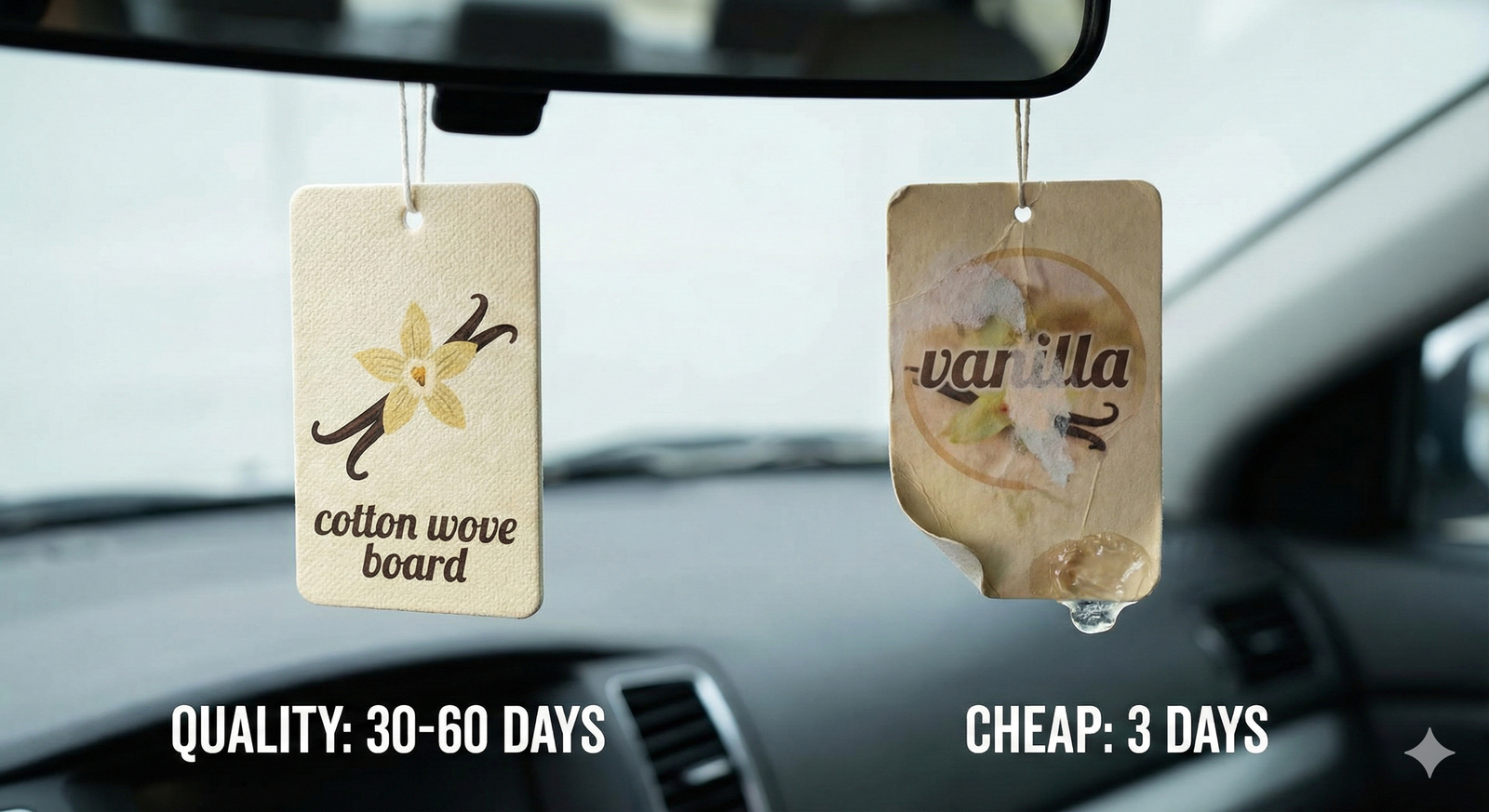
The good ones use cotton wove board that absorbs 40% more fragrance than regular cardboard, professional-grade fragrance oils that actually smell like what they claim, and specialized printing that won't fade or peel when your car hits 100 degrees. The cheap ones cut every corner imaginable – basic cardboard that can't hold scent, synthetic fragrances that smell nothing like the real thing, and printing that starts peeling before you even open the package. Understanding the actual car air freshener manufacturing process changed how I shop for these things completely, and it'll probably change yours too.
The Foundation: Material Selection Makes All the Difference
You know what separates a quality air freshener from those cheap ones that lose their scent in two days? It's all about the base material. Most manufacturers cut corners by using basic cardboard, but that's where problems start. According to industry research, specialized cotton wove board absorbs up to 40% more fragrance than traditional cardboard while maintaining structural integrity.
The car air freshener manufacturing process begins with choosing between several material options. Cotton wove board has become the gold standard because it doesn't get that "wet" appearance when soaked with fragrance oils. Plus, it releases scent gradually over 30-60 days instead of dumping it all at once. Smart manufacturers invest in this premium material because it makes such a massive difference in the final product quality.
Speaking of materials, modern producers increasingly opt for eco-friendly options. Recyclable cardboard containing 25% post-consumer waste has become standard in the industry. These sustainable choices don't just help the environment – they appeal to conscious consumers who care about their carbon footprint.
Fragrance Science: More Than Just Mixing Scents
Here's something that might surprise you: creating the perfect car freshener scent involves serious chemistry. The typical fragrance formula contains 80-85% fragrance oil combined with 15-20% hexylene glycol, which acts as a carrier to help the scent adhere properly and evaporate slowly. Professional perfumers spend months developing each fragrance profile, balancing top notes, middle notes, and base notes to create scents that evolve over time.
In my experience working with custom promotional products, fragrance selection can make or break a product. The most popular scents for 2024 include New Car (that crisp blend of citrus and musk we all recognize), Alpine Fresh with its water lily and cedarwood notes, and Forest combining pine needles with subtle mint undertones. Each fragrance undergoes extensive testing to ensure it maintains its character throughout the product's lifespan.
The fragrance infusion process itself requires precision timing. Manufacturers typically use one of three methods: soaking, where cardboard pieces sit in sealed containers with fragrance solution for 24 hours; gravure printing with fragrance-infused ink; or micro-encapsulation technology that creates tiny fragrance capsules on the surface. Each method has its advantages, but soaking remains the most common for ensuring even distribution.
The Art of Printing: Bringing Designs to Life
Now we get to the visual magic – custom air freshener printing. Gone are the days when screen printing was your only option. Today's manufacturers use multiple printing technologies to achieve stunning results. Digital printing dominates the industry because it allows for photographic quality images and intricate designs that screen printing simply can't match.
The printing process typically happens before fragrance application to prevent the oils from damaging the design. Modern digital printers use special UV-resistant inks that won't fade when exposed to sunlight through your windshield. White ink technology has been a game-changer too – it creates bright, vibrant backgrounds that make colors pop against the slightly off-white freshener board.
Let me share what I've learned about print preparation: artwork should ideally be vector-based, saved as EPS or AI files. For photographic images, you need at least 300 DPI resolution to avoid pixelation. Double-sided printing has become standard, with many manufacturers offering different designs on each side at no extra cost. That's brilliant for promotional products where you want branding on one side and instructions on the other.
Precision Cutting: Shaping Your Freshener
After printing comes the cutting stage, where those printed sheets transform into individual fresheners. Die cutting remains the industry standard because it produces clean, uniform edges every time. Manufacturers create custom steel dies for unique shapes – everything from traditional trees to company logos, sports team mascots, or pretty much any design you can imagine.
The die cutting process involves placing printed sheets onto industrial presses that can exert thousands of pounds of pressure. Some facilities process up to 10,000 pieces per hour using automated systems. Laser cutting offers an alternative for small batches or prototypes, though it's slower and more expensive for large production runs.
Quality control during this stage is crucial. Operators inspect cuts for smoothness and accuracy, removing any pieces with rough edges or alignment issues. Even tiny imperfections can affect how the freshener hangs or how customers perceive the product quality. That attention to detail separates professional manufacturers from fly-by-night operations.
String Attachment: Small Detail, Big Impact
You might not think much about that elastic string, but it's actually a critical component. Manufacturers typically offer 15-20 different string color options to match brand colors or design themes. The attachment process can be manual for small runs or automated for larger orders, with machines capable of stringing 5,000 units per hour.
String quality matters more than you'd expect. Cheap elastic breaks easily or loses elasticity when exposed to heat. Premium manufacturers use UV-resistant elastic that maintains its stretch for the product's entire lifespan. The knot strength gets tested too – nobody wants their freshener falling off mid-drive because of a weak attachment point.
The Packaging Process: Preserving Freshness
Here's where the air freshener packaging process really shines. Individual packaging isn't just about presentation – it's essential for maintaining fragrance potency. Most manufacturers use barrier-coated polyester film that creates an airtight seal, preserving scent for up to two years when stored properly.
The packaging equipment operates with impressive precision. Heat-sealing machines create three-sided seals, leaving one edge open for product insertion. After placing the freshener inside (often with automated pick-and-place systems), the final edge gets sealed. Many packages include "easy tear" tabs for consumer convenience – a small touch that makes a big difference in user experience.
For retail-ready products, header cards or backer cards get added during packaging. These provide space for banding information, usage instructions, and required safety warnings. The entire package then goes through quality checks for seal integrity, print alignment, and overall presentation. Damaged or improperly sealed packages get pulled from the line immediately.
Quality Control: Ensuring Excellence at Every Step
Throughout the manufacturing journey, quality control checkpoints ensure consistency. Raw materials get tested for absorption capacity and structural integrity. Fragrance batches undergo gas chromatography analysis to verify composition. Printed pieces face color matching against Pantone standards. Even the final packaged products go through random sampling for scent strength and package integrity.
Statistical process control has become standard in modern facilities. Manufacturers track defect rates, production speeds, and customer complaints to identify improvement opportunities. ISO 9001 certification has become increasingly common as companies recognize that systematic quality management drives customer satisfaction and repeat business.
Environmental Considerations in Modern Production
Sustainability has transformed how car air fresheners are made in recent years. Water-based inks have replaced solvent-based options in many facilities. Fragrance formulations now avoid phthalates and other concerning chemicals. Even packaging materials have evolved, with many companies switching to biodegradable films or minimal packaging designs.
By the way, waste reduction initiatives have made production significantly cleaner. Cutting optimization software minimizes material waste by arranging shapes efficiently on sheets. Fragrance recapture systems prevent volatile organic compounds from escaping into the atmosphere. Some facilities even compost their paper waste or sell it for recycling into other products.
Innovation and Future Trends
The industry keeps evolving with new technologies and consumer preferences. Micro-encapsulation technology allows for time-release fragrances that maintain consistent scent levels for months. Smart fresheners with app connectivity let users control intensity or receive replacement reminders. Even augmented reality features have appeared, where scanning the freshener with your phone reveals hidden content or promotions.
Plus, customization options continue expanding. Print-on-demand services now let individuals create single custom fresheners affordably. Variable data printing enables mass customization where each freshener in a batch can have unique elements like names or serial numbers. These capabilities open entirely new market opportunities for promotional products and personalized gifts.
Bringing It All Together
The complete journey from raw materials to packaged product typically takes 3-4 weeks for custom orders. Standard designs might move faster through pre-printed inventory systems, but custom work requires careful coordination between design approval, printing, fragrance application, cutting, stringing, and packaging. Each stage builds upon the previous one, creating a final product that seems simple but represents considerable manufacturing sophistication.
Understanding the car air freshener manufacturing process gives you new appreciation for these everyday items. Whether it's a promotional giveaway or a retail product, tremendous thought and engineering go into creating something that effectively delivers fragrance while maintaining visual appeal for weeks or months.
Ready to create your own custom car air fresheners? Browse our complete selection of custom promotional car air fresheners and discover how professional manufacturing can elevate your brand. From unique shapes to premium fragrances, we'll guide you through every step of creating memorable promotional products that keep your business top-of-mind.